




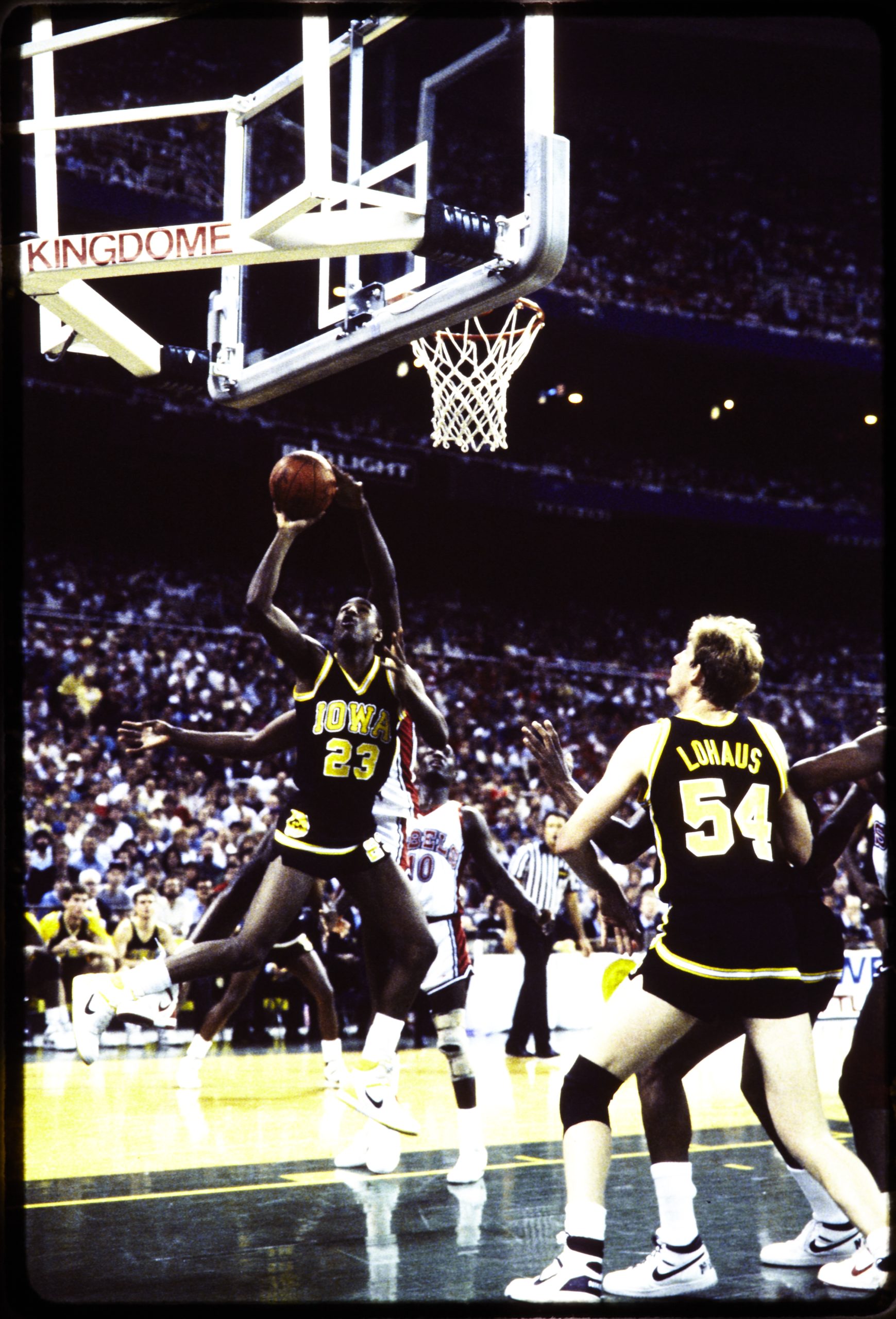
Looking back at the day in March 1987 when Gerald Paddio made himself known to Hawkeye fans

By Pat Harty
On March 22, 1987, Gerald Paddio became a name that Iowa basketball fans would like to forget, but some probably can’t because of the devastation that he caused on that early spring day almost exactly 39 years ago
That’s when Paddio made four second-half three-pointers as part of a 24-2 scoring run that erased a 16-point halftime deficit and that ultimately carried the UNLV Rebels to an 84-81 victory over Iowa, and to the 1987 NCAA Final Four.
Paddio, a 6-foot-7 forward, had been in a shooting slump, but then he suddenly caught fire in the second half in Seattle.
And with Paddio draining threes, and with power forward Armen “The Hammer” Gilliam controlling the paint, Iowa became vulnerable, first losing the momentum, then the lead, and then ultimately the game.
The loss in the Elite Eight ended one of the most satisfying and entertaining seasons in program history; Tom Davis in his first season as head coach took a roster that was packed with size, talent and depth, and that was mostly assembled by previous head coach George Raveling, and molded it into a well-oiled machine.
Iowa finished 30-5 that season, but it’s loss number five that still burns, and that still haunts Iowa fans, because it happened deep in the NCAA Tournament, and because it laid to rest an Iowa team that Bob Knight claimed was maybe the most talented team he ever faced as a head coach.
The Elite Eight is now suddenly relevant again for Hawkeye fans with No. 9 seed Iowa preparing to face No. 3 seed Illinois in the Elite Eight on Saturday in Houston.
Ben McCollum is also in his first season as the Iowa head coach, as was Tom Davis 39 years ago.
But that’s about where the similarities end between the two teams.
The 1986-87 squad was considered a legitimate title contender once the pieces were in place and the wins started to accumulate, whereas the current Iowa team has been a work in progress, sometimes a slow work in progress, finishing 10-10 in conference play.
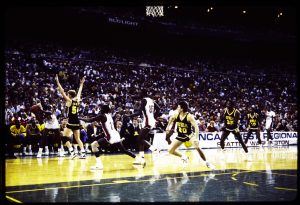
Iowa’s 1986-87 season featured the emergence of point guard B.J. Armstrong, small forward Roy Marble and power forward Ed Horton as a powerful sophomore triumvirate.
All three players thrived in Davis’ fast-paced offense and the wins, the dunks, and the fastbreaks, started stacking up in record-breaking fashion.
The 30 wins still is a single-season program record.
But then in the span of about two hours, the season was over.
In the time that it took for me to drive to work on that March day in 1987, Iowa’s lead had evaporated.
The loss still festers; Paddio’s threes shredding the net, Gilliam pounding bodies inside on his way to scoring 27 points, and UNLV coach Jerry Tarkanian sucking on that white towel.
Kevin Gamble made a late three to cut the deficit to 82-81, but it was too little and too late.
The fun was over, as were the Hawkeye careers of seniors Brad Lohuas, Gerry Wright and Kevin Gamble.
Mike Hlas covered the loss to UNLV in 1987 for the Cedar Rapids Gazette and he remembers then Iowa Sports Information Director George Wine handing out information to the media at halftime about covering the Final Four in New Orleans.
It made sense that Wine would be planning ahead with Iowa leading 58-42 at halftime.
But now with 39 years of hindsight, the lesson from this game is that the momentum can shift in an instant, due mostly to the 3-point shot, making few leads safe.
Hlas said Friday that he still remembers the scene in the locker room after the loss to UNLV.
This is part of what he wrote in the Gazette afterwards:
“If you’d have dropped a pin in the Iowa dressing room minutes after the Hawkeyes dropped an 84-81 basketball decision to Nevada-Las Vegas, the noise would have scrambled your brain. The result of Sunday’s NCAA West Regional final caused a lot o teams and soul searching in the Iowa camp.
The huge lead dissolved and the Hawkeyes were second best with the game on the line.
It hurt.
Iowa assistant coach Bruce Pearl comforted a grieving Brad Lohaus.
Another assistant, Gary Close, sat alone in a corner locker stall with his head down.
Players and coaches were spread throughout the spacious Kingdome team quarters, sitting by themselves with their heads in their hands. Team physician Dave Johnston tried to console Roy Marble, but Marble kept his back to everyone in the room and let the tears flow.
Soon players and coaches pulled themselves together enough to discuss how UNLV jumped off the canvas to earn a trip to the Final Four.
The words, however, were often forced. Smiles and good feelings were few and distant.
It will take a little time for Iowa’s player to put aside Sunday’s loss and appreciate what a superb season they had. Or what could have been.”
The fact that Iowa played at a fast pace under Davis, and also liked to press on defense, probably made it easier for UNLV to come back because there were more possessions than a game played at a slower pace.
Illinois would be in some trouble on Saturday if it were to trail this current Iowa team by 16 points at halftime because of the way Iowa plays; slow and deliberate, using the clock to its advantage.
Iowa’s 1986-87 squad only knew how to play one way, fast, furious and above the rim, and it was a joy to watch until it was over.
Roy Marble and Armen Gilliam sadly are no longer with us.
Marble passed away in 2015 from cancer at the age of 48, while Gilliam passed away from an apparent heart attack in 2011 at the age of 47.
But on that March day in 1987, Armen Gilliam truly was the hammer, while Gerald Paddio was the executioner, and together they helped to bring down an Iowa team that had thrilled its fans throughout the season.
It hurt then, and still hurts now, 39 years later.


