





After nearly 60 years; time for Iowa and Notre Dame to renew football rivalry

By Pat Harty
IOWA CITY, Iowa – Oct. 5, 1968 is a significant date in the history of the Iowa football program even though the Hawkeyes lost by 23 points at home that day.
That day marked the last time that Iowa and Notre Dame have faced each other in football, almost 58 years ago.
The Fighting Irish left Iowa City that day with a 51-28 victory, compiling 587 yards before a sellout crowd.
It was Notre Dame’s fourth straight win over Iowa and none of the four games were competitive as Notre Dame won by a combined margin of 170-46.
Iowa would go on to finish the 1968 season with a 5-5 record under third-year head coach Ray Nagle, while Notre Dame finished 7-2-1 under head coach Ara Parseghian.
As somebody who grew in Des Moines cheering for both teams as odd as that might seem, it’s time to look into renewing this once-proud rivalry.
It’s long overdue for Iowa and Notre Dame to schedule a home-and-away series, or at least face each other at a neutral site.
Because if Wisconsin can do it, then so can Iowa.
The Badgers will face Notre Dame in the 2026 season opener on Sept. 6, which is a Sunday, at Lambeau Field in Green Bay, Wisconsin, while Iowa will face Northern Illinois in its season opener on Sept. 5 at Kinnick Stadium, and for the 11th time since 1985.
The skeptics will say that as long as Iowa has to play Iowa State every year, there isn’t enough scheduling flexibility to fit in another Power Four opponent such as Notre Dame.
However, that also seems to be another way saying that facing two Power Four nonconference opponents in the same season is just to risky, especially with the Big Ten now having 18 teams that stretch from coast to coast.
The Iowa-Iowa State contract runs out after the 2027 game in Ames, and Hawkeye fans have mixed feelings about whether the series should be extended.
I believe it should for multiple reasons, including the fact that it’s now a highly competitive series.
It also is arguably the biggest annual sporting event in the state.
Some Hawkeye fans are convinced that Iowa would replace the Cyclones with other Power Four opponents that are just as good, or even better.
Okay, if that were to be the case, then Notre Dame should be at the top of the wish list.
From 1951-1964, Iowa ended its regular season against Notre Dame, except for the day following President Kennedy’s assassination in 1963. It mostly was a competitive series during that time as Iowa compiled a 5-6-2 record.
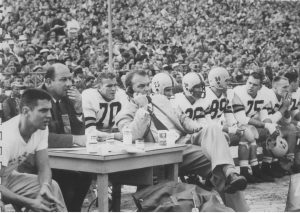
The rivalry was also heated at times, and that was never more apparent than the 1953 season when Iowa and Notre Dame played to a 14-14 tie in South Bend, Indiana, much to the dismay of Iowa head coach Forest Evashevski, who accused the Fighting Irish of using what were described as “desperate clock-stopping maneuvers” to avoid defeat.
Notre Dame had one, two and sometimes even more players stretched out on the field after numerous plays, supposedly because they were injured. But Evashevski and Iowa fans were convinced that the Notre Dame players were faking injuries as a way to stop the clock. It was considered an act of desperation by Frank Leahy’s squad, but it ultimately helped the Fighting Irish avoid losing as they scored on a touchdown pass with six seconds left to play and then converted the point-after kick to even the score at 14.
And while Notre Dame avoided losing the game, its strategy of stopping the clock was widely criticized.
Evashevski remained bitter after the tie and he expressed his feelings about the “fainting Irish” “by paraphrasing the words of legendary sports writer Grantland Rice:
“When the one great scorer comes to write against our name, he won’t ask what we won or loss, but how we got gypped at Notre Dame.”
Hawkeye fans rallied around Evashevski’s now-famous words and the relationship between Iowa and Notre Dame in football has never been the same.
The teams would go on to play 12 more times, including seven times with Evashevski coaching the Hawkeyes. Iowa finished 4-3 in those seven games from 1954-60, highlighted by a 48-8 victory in Iowa’s 1956 Rose Bowl season.
So Evashevski certainly gained some revenge over Leahy and the “fainting” Irish.
Iowa and Notre Dame both have certainly had their peaks and valleys since they last played in 1968.
Iowa suffered through 19 consecutive non-winning seasons from 1962 to 1980, while Notre Dame hasn’t won a national title since 1988 and combined to finish just 30-26-1 in five seasons under Gerry Faust from 1981 to 1985.
Notre Dame also had losing records in 1999 (5-7); 2001 (5-6); 2003 (5-7); 2007 (3-9); and 2016 (4-8).
Iowa, on the other hand, has only had one losing season since 2007, finishing 4-8 in 2012.
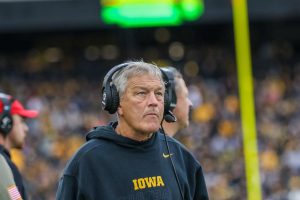
Iowa vs. Notre Dame would match the Big Ten’s all-time winningest coach in Iowa’s Kirk Ferentz against one of the most storied programs in the history of college football.
Both teams are also from the Midwest with the state of Illinois all that separates them.
Notre Dame has a long history of playing Big Ten teams, while the Big Ten has a recent history of wanting to add Notre Dame to the conference.
It just seems kind of silly that Iowa and Notre Dame haven’t played for over a half century.
Before I wrap this up, it’s worth noting my bias in this case.
I grew up in a home where Iowa and Notre Dame were both put on pedestal.
My father attended Notre Dame on a football scholarship from 1945-49, while my older brother attended Iowa on a football scholarship from 1978 to 1981.
My mother was also a die-hard fan of both teams. She loved Notre Dame because she was married to a former Notre Dame player for nearly 70 years and she loved Iowa because she grew up cheering for the Hawkeyes, adored Forest Evashevski, and her son played for Iowa.
Mom used to tease dad by saying if he didn’t behave, she would leave him for Forest Evashevski.
I’ve often asked myself who I would privately cheer for if Iowa and Notre Dame ever met in football again.
I’ll never know for sure until when, or if, it were to finally happen.
But my guess is that Iowa would have the emotional advantage based mostly on having covered the Iowa football beat for over 30 years. After so long, you grow attached to something that plays such a pivotal role in your life.
I just hope I get to answer that question before retiring, though I’m not overly optimistic.


