




Book by Omaha businessman makes case for Iowa football national championship

By Mike Hlas
IOWA CITY, Iowa – Iowa had a national-championship football team that deserves that recognition in Kinnick Stadium.
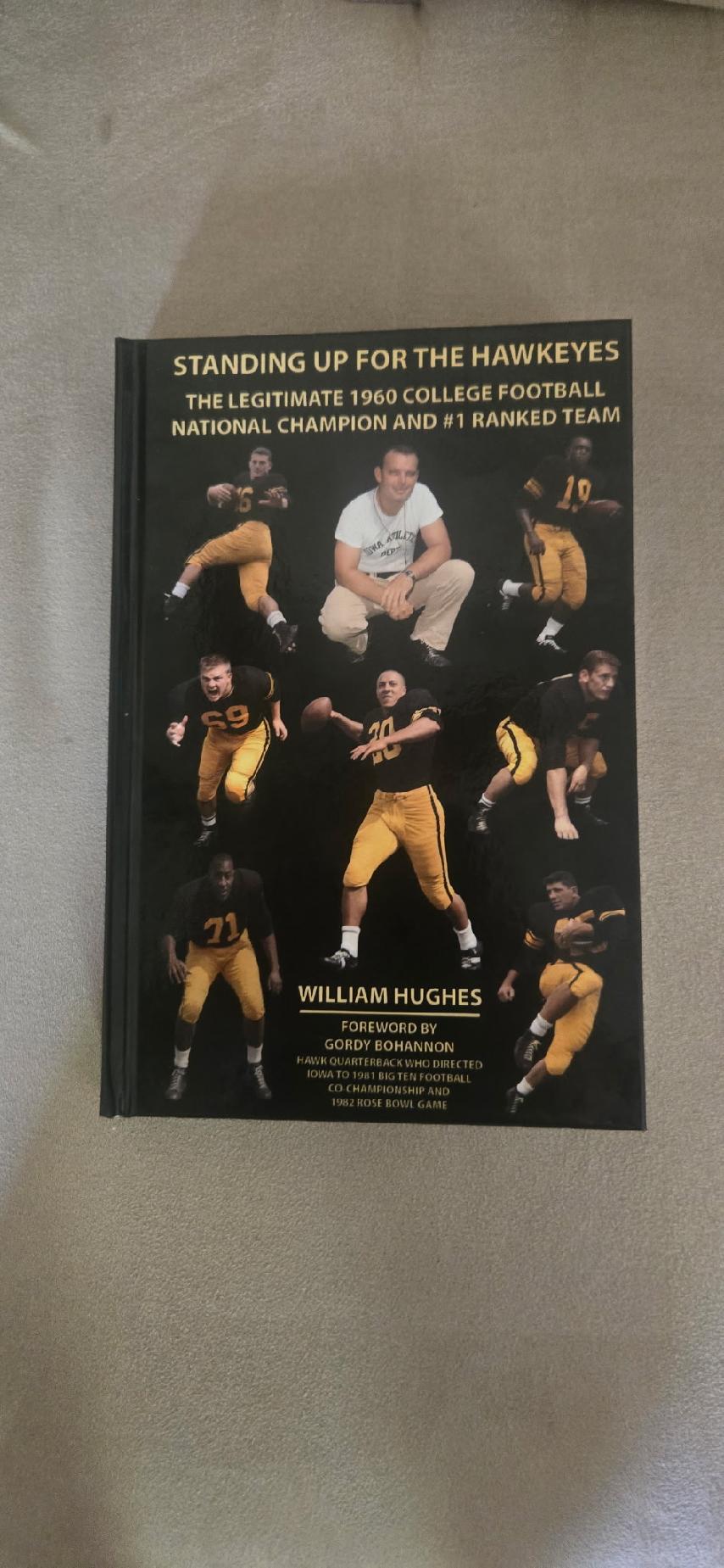
That’s the conclusion of William Hughes, an Omaha businessman and lifelong Hawkeyes fan who has done more than simply state an opinion. Hughes spent time over the last five years researching and writing a book about the 1960 Iowa team called “Standing Up for the Hawkeyes: The Legitimate 1960 College Football National Champion and #1 Ranked Team.”
Last October, the University of Minnesota honored its 1960 national-championship football team on the weekend of a home game. The stadium’s brick facade perimeter on its upper deck had already commemorated the title. The Gophers were No. 1 in the final Associated Press rankings that season.
Hughes, however, lays out a statistical argument for Iowa and then some. That last AP poll was conducted before some late regular-season games and all the bowl games were played. Minnesota, by virtue of a Pacific-8 Conference vote, was selected to play in the Rose Bowl instead of the other Big Ten co-champion, Iowa. Washington then defeated Minnesota, 17-7, the Gophers’ second loss in their last three games.
In those pre-playoff days, all sorts of organizations awarded mythical national-titles. Mississippi, Missouri and Washington also were named the champion by various entities. So was Iowa, named No. 1 by four different research outlets as noted in the Hawkeyes’ football media guide.
The Hawkeyes were 8-1 that season with a late-season 35-12 upset triumph over then-No. 3 Ohio State in Iowa City, one of the greatest wins in school history. Iowa was third in that final AP poll, released in November. Yes, it lost at Minnesota, 27-10, after leading 10-7 in the third quarter despite three starting linemen being unavailable because of injury. Did Iowa have a superior body of work, however? Let’s put it this way: Seven of its eight wins were against teams ranked 12th or higher, and the other was at Notre Dame.
Iowa’s strength-of-schedule easily was No. 1 in the nation that year. You could argue it was the toughest any major-college team has ever played. You could also suggest the Hawkeyes should have been No. 1 in the final poll even with their loss at Minnesota because of their overall credentials. Hughes has that opinion shared in his book by poll-evaluators and college football experts. Beating seven ranked teams by an average of 16.4 points is a pretty good starting point.
Besides defeating then-No. 1 Iowa, Minnesota had just two other wins over ranked teams, and none over anyone in the Top Ten. Iowa’s midseason non-conference game was a 21-7 win over Kansas, which went 6-0-1 in the Big Eight. Minnesota’s was a rout of Big Eight last-place team Kansas State.
So Hughes wrote a hard-cover book about this, and not for profit. In fact, he’s giving it away. Those who want ask for a copy can send an email to [email protected] for information on how to receive one. I recently met up with Hughes in Cedar Rapids when he was here to present a copy of the book to Nadine Hollis, the widow of the quarterback of that 1960 Hawkeyes squad, Wilburn Hollis. He explained why he was moved to write the book.
“I just felt that somebody needed to stand up for the 1960 team,” Hughes said, “and I definitely felt they were the legitimate national-champion and No. 1-ranked team.
“The AP poll had nothing to do with the end of the season nor any of the bowl games, and there were quite a few upsets in the Top Ten after that poll. I noticed Iowa recognized the title in the media guide, but I never understood why they didn’t expand on it more.
“Where you should earn it is on the field, and they did. I felt it’s as simple as that.”
Though he attended Upper Iowa and then graduated from Arizona State, Davenport native Hughes is a self-described “avid Hawkeye fan.” In his 70s, he’s a longtime season-ticket holder and donor. He knows Iowa football history and sinks his teeth into it in his book.
Even those who support Minnesota or another team other than Iowa to be No. 1 that season would have to concede Hughes presents a worthy argument for the Hawkeyes. And even those who disagree could find the story of the 1960 Hawks to be worth the read in itself.
It was a team with low preseason expectations, to say the least.
College football had switched back to single-platoon in 1953 to save money on scholarships, and didn’t revert to true full-platoon football until 1964. Thus, if you played, you played both ways. Iowa Coach Forest Evashevski, whose 1956 and 1958 Hawkeye teams are the last two Iowa clubs to win Rose Bowls, had nine first-time starters among his 11.
“There were a lot of people questioning whether Evy should coach that team because they thought it was going to be so bad that it would detract from the great record he had built, and he had a lot of opportunities at that time. But he was very loyal to those guys.”
It turned out to be Evashevski’s last team. He retired from coaching after the 1960 season and became Iowa’s athletic director. He believed in his 1960 guys well before anyone else.
During Hughes’ recent in-home visit with Jerry Mauren, captain/halfback/defensive back of the 1960 Hawkeyes, the former player said “Evy always had your back.”
Entering the season, however, the players were realistic about the rugged schedule they faced. There wasn’t an automatic win among the nine games. Fatigue and injuries were a threat to bring the Hawkeyes down even if opponents couldn’t, and a commonality during the season was Iowa jumping to lead then wearing down a bit — but not too much — in the second half.
Before the 1960 campaign began, Iowa players called it the “Season of Doom.” They clearly didn’t take those words to heart once the games started. Down went No. 10 Oregon State in the opener. Down went No. 6 Northwestern in Evanston, 42-0. Down went No. 8 Michigan State in East Lansing. Down went No. 10 Purdue and No. 9 Kansas. The latter’s only losses were 14-7 to then-No. 2 Syracuse and 21-7 at Iowa while the Hawkeyes were in their 3-week run at No. 1.
Down went Ohio State, with a thud after sportswriters across the Big Ten, the nation, and Iowa itself picking the Buckeyes to prevail. Coming off their demoralizing loss at Minnesota the week before, the Hawkeyes rebounded and ran over a Woody Hayes-coached squad that seemingly had a clear path to the national-championship. Larry Ferguson, an All-America selection at halfback by the Football Writers Association of America, took a handoff from Hollis and darted around right end for a 91-yard touchdown to put the game away.
“The Hawkeyes were an absolutely superior team in every respect,” wrote Dayton Daily News sports editor Si Burick after the game. “They earned their five touchdowns on thorough superior backfield speed, offensive imagination, line charge, and defensive alertness when it counted.”
After Iowa ended its regular-season with a 28-0 win at Notre Dame, it waited to see if it would be headed to Pasadena. In the event of a co-championship in the Big Ten, the Pacific-8 (known as the Pacific Coast Conference when the teams started playing each other in the Rose Bowl) selected the school to represent the Big Ten.
Hughes writes: “The media believed Iowa would receive the invitation because Iowa had voted in favor and Minnesota had voted against extending the Rose Bowl agreement.”
But Minnesota got the call.
“Washington had played in the prior Rose Bowl,” Hughes said, “and they pounded Wisconsin (44-8). They kind of liked playing those slow teams. The Hawkeyes were a lot different. They were a fast team. So if (Washington) had any say, they’re probably telling their league ‘Hey, we’d rather play Minnesota.’ Which ended up to be accurate when at halftime the score was 17-0, Washington.”
So, there was no Rose Bowl and no consensus No. 1 recognition for that Iowa team. Sixty-six years later, Hughes would like to see a new honor come the way of the ’60 Hawkeyes. That’s acknowledgment for a national-championship during a Hawkeyes game in Kinnick Stadium.
In 2007, Washington recognized its 1960 team as national-champions, an honor bestowed upon it 47 years earlier by the Helms Athletic Foundation. A flag signifying the team as national-champs was unfurled in the UW’s Husky Stadium.
“If we could get Iowa to do this, it would be like at the University of Washington where they invited the players who are still living or family members of those who aren’t to come back.”
One of those players probably will be in Kinnick, anyway. Tom Moore, now 87, was the placekicker for the 1960 Hawkeyes. Ferentz hired him this year as a senior consultant and offensive analyst. If Moore can serve up a few of those plays to offensive coordinator Tim Lester and they have similar success to when they chopped down mighty Big Ten teams 66 years ago? He’ll be worth whatever Iowa is paying him.
And if the Hawkeyes can enjoy a similarly successful season to their ’60 ancestors? They won’t need any other conference to invite them to the College Football Playoff. They’ll be going in style.


