




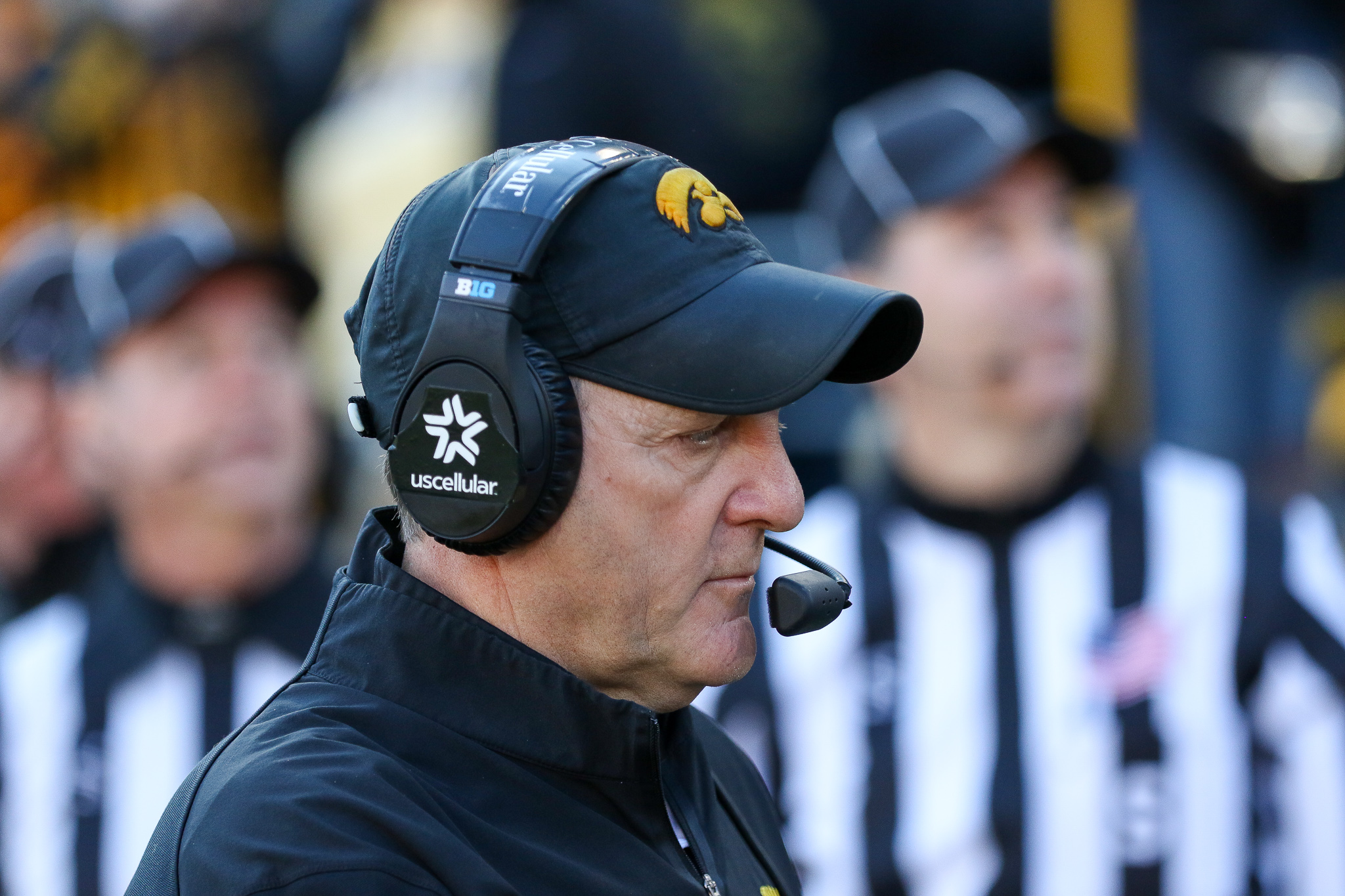
Iowa defensive coordinator Phil Parker 10/13/26 press conference transcript

IOWA CITY, Iowa– Iowa defensive coordinator Phil Parker met with the media on Tuesday as part of the bye week.
Here is his entire press conference transcript:
**********
PHIL PARKER: Well, I hope some of you made it out to the West Coast. Obviously, it was a short week for our guys, and I think our guys handled that pretty well. Hopefully, you enjoyed the trip.
Now we are coming back into the bye week. Can we handle the bye week and take advantage of the opportunity with the time that we have to improve some things that we need to improve on and get some guys fresh again, and start the second half of the season? Obviously, we’re happy to be 5-1 right now. I’d like to be 6-0, but we’re 5-1, and now we’ve have to take care of the second half of the season. Obviously, Minnesota will be the first one in about a week and a half.
Q. Entering the season we talked a lot about the defensive line and all the production that you guys lost. It seems like Bryce Hawthorn is a guy who continues to get better and better each week. How have you seen him continue to ascend here since the beginning of the season, and how has he embraced emerging as a leader across the defensive line?
PHIL PARKER: We showed a clip a couple days ago of Bryce actually making a great effort play on the sideline. We had a missed tackle in the flat right in front of our bench, and you saw Bryce start running after him. It was the way he’s grown a little bit, the effort that he was putting in, and the leadership. He’s hard to block, as you see, and he’s very active. When somebody does that, it establishes that leadership role. That kid is playing very hard and going full speed all the time, and people respect that. I think he’s really done a good job getting back healthy and playing well.
Q. I wanted to ask about the secondary. With Tyler Brown being out with his injury, you’ve had Anthony Hawkins—who you talked about in the preseason as someone who stepped up—and then we saw Xavier Styles at Washington. Where have you seen the strong safety position evolve with Brown’s absence? How do you feel that group is continuing to show improvement from what you’ve seen, and what do they need to continue working on?
PHIL PARKER: When you bring new guys into your program—and all three guys have played: Tyler, Hawkins, and Styles—the communication has to be there. I think Tyler Brown was very excellent when he first started; he had command of knowing what was going on. Now you have Xavier and Anthony Hawkins learning our system, and communication is a big part of that. They are growing every day. What I saw last week with the way Xavier Styles moved around, he made some plays and is very active. He just needs to be a little bit more vocal. Lutmer is trying to help him along, and Tyler Brown helps him out by communicating what we need from him. Good communication is very important because for everything people do to us on offense, we have slight adjustments, and everybody has to be on the same page. If you’re not on the same page, there’s going to be a mistake. They’ve been growing, and I like to see it. They just need to be a little bit more vocal out on the field and show more confidence.
Q. I’ve got two completely different questions. One is, it seems like you’ve brought back the Raider package in some ways. What is it about the unique characteristics of some of your young defensive linemen that allowed that to grow? And my second question: you played against Anthony Carter, you’ve coached against Ray Lewis, you’ve seen many of the greatest receivers in Big Ten history—where does Jeremiah Smith rank in that category?
PHIL PARKER: I’ll start with him. He’s a good wide receiver; he’s unique. There were times we had him triple-covered, and he still catches the ball. A guy like that, how he handles himself—the one thing I respect out of him is that he produces. I think he ranks pretty high. I played against Anthony Carter and those guys, and they are very, very good. Matter of fact, I talked to the offensive coordinator after the game and said he should probably be picked first in the draft. He probably thought he was top five in the NFL right now, which is a pretty good sign of a good player. He showed it, and I think he keeps doing that. The way he handles himself makes him a real good pro, whether he’s in college or the NFL.
To go back to the Raider package: going into it, we were looking at playing against quarterbacks who can move around a little bit. I think that helps us and gives us a chance to put Preston Ries back on the field a little bit. He’s a guy who can not only chase them down, but he can catch them, and I think that’s proven. It’s an opportunity for us to get guys on the field who can help us in different areas, especially on third downs. We’ve been putting in different packages, and hopefully we keep adding things we can do within that package. I think it’s been a benefit, but we’ll see how it goes. When you take a guy off the field and there is a change of possession, or they get a first down, you have to be able to operate very quickly if someone wants to go fast on you. So you have to be able to play your basic defense within the Raider package. We’ve been working on that and will continue to build on it all the way through the rest of the season.
Q. About Washington, can you walk through the game plan in place to make Demond Williams uncomfortable? It seemed like you collapsed the pocket a lot, and the linebackers were making life difficult for him. On the flip side, is it just scouting the backup quarterback? Elijah Brown was really efficient in that second half. How did you evaluate that when you looked at it?
PHIL PARKER: When you go back and look at it, it’s a totally different situation. Obviously, he didn’t have too many reps on the offensive side with the ones when he was at Washington; they were practicing, and he supposedly only had two reps with them. So it’s a change-up, but I think we started looking at how we played, and we really played fast. I thought the biggest thing for us going into that game was starting fast and making sure we were on top. When you look at the first and second quarters, there were probably two drives in the first half that we weren’t really pleased with. Coming in at halftime, how did we respond to that, knowing the quarterback got knocked out, didn’t come back and play? Are there major differences we’re going to make call-wise? Probably not. I just think it was more about us than about him, and he got the ball out quick. The other kid was good, but he couldn’t see downfield a little bit, so that was helping us. But this guy came out and threw the ball well. You look at it and ask why it happened. We gave up a 15-play drive and then another 15-play drive at the end, and I heard about that when I got home at 6:30 in the morning from my wife.
So, I get it. We get frustrated. It’s not like we try to give these things up. We’re trying to play our best, and we’re going to continue to try to do that even this week—practice the best we can, prepare, and every time we go out, play our best. Can you play your best and push these guys to that level? I think there’s a great deal of leadership within our team that looks very positive, but you have to continue to do it every day. You can’t go out there and let up. For whatever reason it was—lack of communication, missed tackles, pass interferences—we had five or six pass penalties in the second half. We didn’t have any penalties in the first half. That added to their drives, and you can’t do that. You have to be smart about it, whether it’s pass interference, holding, or whatever it is. You can’t miss tackles; if you miss tackles, they get an explosive play on you. You just keep working on it daily, and that’s the way we look at things: evaluate it and figure out what we can do better.
Q. I wanted to ask about Cam Buffington and his development. What have you seen from him as he matures into one of the leaders of the defense?
PHIL PARKER: Great leadership, a great communicator. There are a lot of different adjustments up front that he and Jaylen Montgomery have to make—they are both in it together. To see him grow… he’s a quiet kid, he’s not going to say very much, but he plays the way he plays. He makes a statement as far as how tough he is, how he sees things, and he plays fast. The only way that happens is with preparation, the dedication he has, and the sense that this is important to them. You only play college football for four or five years at most, and it’s a very short time, so you better make sure you take advantage of it. Our guys work at it, believe in what they’re doing, and spend extra time. Some guys don’t understand it because they think you go to class and go back, but these guys are usually coming back here watching film together after our meetings. I think it’s a real positive, and he’s really grown. He still has a little bit more upside to him, and he loves the game.
Q. What have you seen from Kamari Brown so far this year?
PHIL PARKER: He’s really done a good job. He was in a situation as a new guy coming in, but he had that little burst and he goes hard every day. That shows me the way he goes about his work. You see it in practice, and then it shows up on the field. He hasn’t been here very long, so those are things you have to deal with, but he’s bought into what we believe in and how you have to go about your business, and he’s doing it. I’m very pleased with him.
Q. I was checking, you guys have had one turnover caused against power conference opponents at this point of the season. Last year, that number was six. I know interceptions are a stat you care about, but they’re glamour stats that fans really care about. How do you try to get that number up a little bit while still leaning on the platitude that Riley Moss once told me, which is just don’t try to do too much, just do your job and the interceptions will come?
PHIL PARKER: It’s an interesting fact because we talk about it as a staff and with your players, and sometimes guys go in there and say, “I have to make this play, I have to make an interception, or I have to cause a fumble.” The best thing—and actually it was on Sunday morning, I was walking in and I called Tom Morrell and talked to him a little bit, and he goes, “You know, just go ahead and keep doing what you’re doing, and the plays will come to you.” Don’t try to force it. I think some guys sit there and start talking about it so much that everyone tries to take a chance.
The best way you can look at it—and I went back and looked at it too—is takeaways are nice to get and nice to score off of, but it’s also nice to get off the field in three and out. I think there were a couple of series at the beginning of that game where we had minus-nine yards, and they had 12 yards and three-and-out. It worked in our favor that we were getting the ball back to give to our offense to give them an opportunity to take it down and score. Sometimes it’s really weird because we’re working just as much as we always have about takeaways, and sometimes you just don’t get them. Also, the more press coverage you play and press on receivers, it’s harder to see the ball if you’re not playing a whole bunch of zone defense. If you’re playing structurally defensive zone, you get to see the ball a lot more, and guys are looking, can see it, and can react to it. I’d like to get more three-and-outs, and hopefully we can score on a turnover and keep that record going a bit. But we’re always talking about getting the ball back one way or the other—whether you stop them in three and out and let the punt returner take it down and still have good field position.
Q. I wanted to ask about Marcello Vitti, but before I do that, does your wife usually give you an assessment after the game on how the defense did?
PHIL PARKER: Better stop there. She gives me evaluations on everything. How I cut the grass, how I clean the bathrooms at home, all that stuff.
Q. So, Marcello, he was on the depth chart going into the year with Tyler out. As a freshman, what did he show that got him so highly thought of on the team at that point, having just had a fall camp with the program?
PHIL PARKER: He’s only been here a short time like everybody else. His commitment to understanding what he needed to do… we kind of knew that in recruiting based on the background of the family and what it was all about. He probably spent a lot more time in the summer here than I did. He’s two and a half, three hours in the room studying the game of football, learning, and trying to get the whole system down and knowing what he’s supposed to be looking at. He’s put in a lot of time. Anyone who comes in and has a chance to do that has to invest. Investing means sometimes you might not see exactly what you want, but you build up that interest, and I think that’s what he’s done. You can rely on him, he knows what’s going on, he asks the right questions in meetings, and his effort and toughness all come into it. That’s what made him who he is. If you see him over here, he’ll be in the film room watching it, bringing other coaches in, or bringing my son Tyler in to sit for two hours watching film and explaining what’s going on. That’s how you become good and keep going: investing the time that you have.
Q. Wanted to ask you about Jacob Wallace, obviously being in that cash position—a spot where you put a lot of trust in guys to take over. How have you seen him take on that role, being a guy who came in with a little less experience?
PHIL PARKER: I think he’s done a good job. He’s done some things inside. I remember last year against Nebraska he kind of popped up and we said, “Well, this kid has something to him.” I saw that when we recruited him as a basketball player playing in a game—I think he was really good, competitive, very level, and flat-line as far as emotional things, but he just knows the game a little bit. Obviously, his brother plays for the Rams, so it’s in his background, but I love the way the guy goes about it and competes. Sometimes he gets stuck in the box a little bit and they motion, and he was playing against—I remember it might be the first or second play, and they had a big 300-pounder just grabbing him and tackling him and laying on him. Probably should have been a penalty because you know you can’t land on the quarterbacks, well, he just took him and dumped him and landed on him, so he might be a little bit banged up. But I just like the way he competes. He’s a good athlete, a smart kid, and understands the game of football.
Q. Do you have any sense of when Tyler Brown could be back?
PHIL PARKER: I didn’t take any medical classes; I didn’t go to medical school or anything like that. No, I’m just joking about that, I probably should have.
No, I think in due time. I think you don’t know exactly what’s going on—I don’t know exactly what’s going on because I don’t. But I think when he’s ready, mentally he’s staying into it, so he knows when he is ready to go that he has a chance to get back, compete, and get on the field. It’s kind of an unknown, I don’t know.
Q. The last couple games, there’s been a few times the defensive line has been standing up at the time of the snap and almost walking towards the line of scrimmage. Could you explain the origins of that and what you’re trying to accomplish by doing that?
PHIL PARKER: It came up years ago—we used to do it too, and we brought it back. Sometimes it gives a little bit of energy to the guys. It might be a passing situation, so it’s nice sometimes when they can get up and see exactly where they’re going and move around. It messes around with the offensive line a little bit in terms of who is rushing, who is dropping into coverage, who is blitzing and who is not. We brought it back up, and I think the kids like it a little bit. It’s usually done in a passing situation, so we try to expand that. After a while, when you bring pressure, maybe we just play coverage. Maybe we play three-deep, two-deep, or man, and we can keep adding to what we have. As long as we can do that, it’s going to help us take advantage and keep offenses guessing where the blitz is coming from—and it might not even be a blitz. Today I dropped 11 guys on fourth and two, just to make sure practice went in quicker.


