





One simple, obvious way to improve Iowa’s quarterback play

By Pat Harty
IOWA CITY, Iowa – With all sorts of opinions about what Iowa head coach Kirk Ferentz should do to improve the quarterback play; here’s one simple and obvious suggestion:
The quarterbacks should just play better.
Whether it’s Hank Brown or Jeremy Hecklinski running the offense, just do your job by hitting open receivers, by making the right checks at the line of scrimmage, and of course, by avoiding turnovers, which neither quarterback did in Saturday’s 13-10 loss to Minnesota in Minneapolis.
Hecklinski threw an interception at the Minnesota two-yard line in the first quarter, and then he almost threw another interception near the Gopher end zone.
And by that point, Kirk Ferentz had seen enough so he benched Hecklinski slightly beyond the midway point of the second quarter and put Brown in the game.
But then Brown would go on throw two interceptions, while also missing some open receivers.
Brown passed for 136 yards, but 94 of those yards came on two plays, including a 57-yard pass to wide receiver Tony Diaz, who gained most of the yards after making the catch.
Brown also completed a 37-yard touchdown pass to wide receiver Reece Vander Zee with slightly less than four minutes to play, evening the score at 10-10.
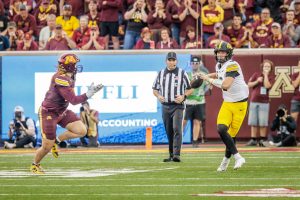
Brown’s touchdown pass to Vander Zee was one of the few plays in which the offense executed in all phases from pass blocking to route running to throwing an accurate pass.
It was the kind of play that is almost routine for lots of offenses, but not for Iowa’s offense.
Rarely has passing or quarterback play been a strength for Iowa under Kirk Ferentz.
Both usually are a work in progress, many times a slow and frustrating work in progress. And while multiple factors are to blame, a lack of consistent productivity from the quarterback position is arguably the biggest factor for Iowa’s struggles on offense, followed closely by an inconsistent rushing attack.
Iowa’s up-and-down rushing attack certainly deserves part of the blame for Saturday’s loss at Minnesota as it marked the fourth time this season that Iowa has been held to fewer than 100 rushing yards.
To question the play calling is also a natural reaction following a loss. But that argument has the benefit of hindsight, and no disrespect to the folks on social media, the Iowa coaches know more than you do.
Iowa didn’t lose to Minnesota because of offensive coordinator Tim Lester’s play calling.
Iowa lost because the running game failed to do its part and because both quarterbacks struggled.
This isn’t to say that Lester called a perfect game, but Iowa’s problems on offense had more to do with execution than with preparation and design.
Being a starting quarterback in the Big Ten isn’t easy, nor is it supposed to be easy.
It’s a privilege that most quarterbacks never come close to achieving.
So Brown and Hecklinski already are in select company, but with that comes a big responsibility.
At this point, Kirk Ferentz seems more comfortable with Brown playing quarterback based on how quickly Ferentz benched Hecklinski in Saturday’s game.
The fact that Hecklinski didn’t even get to finish the first half is pretty telling in that his leash appears much shorter than Brown’s leash.
Ferentz was asked in his post-game press conference what went into the decision to switch quarterbacks in the second quarter. Did he see something in Hecklinski’s performance or was it more a case of trying to give the offense a spark?
The competition between Brown and Hecklinski was so close that both were listed as co-starters throughout preseason practice and through the first two games, though Brown played the entire game against Iowa State in week two.
Hecklinski has what seems to be a significant part of the Iowa fan base in his corner. He started gaining support when he clearly outplayed Brown in the Kid’s Day practice in mid-August.
Hecklinski also completed all five of his passes for 67 yards in the 31-14 loss to Ohio State after replacing the injured Brown in the fourth quarter.
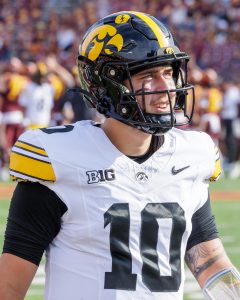
Hecklinski then made his first career start against Washington on Oct.9 in Seattle, passing for 202 yards and three touchdowns in the 41-24 victory.
Kirk Ferentz then announced this past Tuesday that Hecklinski would start against Minnesota, so it was easy to assume that Hecklinski now had the upper-hand.
However, as it turns out, Hecklinski had a short leash, and some probably would say too short of a leash.
But in fairness to Kirk Ferentz, Hecklinski also didn’t play very well before being pulled from the game.
The stage was set for Hecklinski to make a statement, but he failed to do so.
He started on the right track, completing six of his first seven passes. But then he missed on six of his next nine attempts before Kirk Ferentz pulled the plug.
Hecklinski whether it’s true or not has a reputation for being a gunslinger who isn’t afraid to take risks as a passer. The Georgia native also plays with moxie and grit, and he plays loose, sometimes, maybe too loose.
Kirk Ferentz, meanwhile, wants his quarterback to value the football perhaps more than anything else. He wants his quarterback to be reliable, steady and safe.
Mark Gronowski never was a great passer during his one season as a Hawkeye a year ago.
But he was a great runner, setting a program record for a quarterback with 16 rushing touchdowns last season, and he was tough and reliable.
And yet, Iowa still lost four games last season, but finished the season with three straight wins, partly due to Gronowski’s play down the stretch.
Iowa doesn’t have that same running option from its quarterback this season, so that puts even more pressure on the running game and on the quarterback to make plays as a passer.
Prior to Gronowski’s one-year behind center, the Iowa quarterbacks had mostly been average or below average during a five-year stretch from 2020 to 2024.
Not since Nate Stanley has Iowa had a quarterback perform well for an extended period of time. Stanley started three straight seasons from 2017 and 2019 and now ranks second on Iowa’s all-time passing list with 8,302 yards and 68 touchdowns.
But Stanley also never even made third-team All-Big Ten as a Hawkeye.
The last Iowa quarterback to make All-Big Ten was C.J. Beathard, who made second-team in 2015.
Drew Tate was the last Iowa quarterback to make first-team All-Big Ten, but that was in 2004 and before Hank Brown was even born.
Some might blame the quarterback shortcomings on questionable recruiting, but that’s also easy to do with hindsight.
Iowa recruits who it can at quarterback and has been somewhat aggressive in the transfer portal, which is where Brown and Hecklinski both came from in 2025, from Auburn and Wake Forest, respectively.
Ferentz chose not to add a quarterback from the portal this past offseason, showing his confidence in both Brown and Hecklinski, and maybe his desire to save some money.
That decision might start getting criticized if the quarterbacks continue to struggle.
Some also might blame the struggles at quarterback on coaching and strategy because that’s always easy to do in times of struggle.
At some point, though, it comes down to a quarterback having to make plays, and right now Iowa’s quarterbacks aren’t making enough of them.
That isn’t to suggest that the quarterbacks deserve all the blame, but much like when the offense is clicking, most of the attention is on the quarterback.
After back-to-back road games, Iowa now returns home to face a surging Wisconsin team on Saturday at Kinnick Stadium.
The Badgers also have their share of problems on offense, but the Wisconsin defense is playing at a very high level as evidenced by its performance in Saturday’s 24-7 victory over USC in Madison, Wisconsin.
Wisconsin finished with nine tackles for loss, two interceptions and seven passes defended.
Whomever starts for Iowa at quarterback against Wisconsin will face a tough, determined and aggressive defense.
It would certainly help if the Iowa running game were to rise to the occasion and if Lester were to excel as a play caller.
But the quarterback also has to play well to give Iowa a chance to win.
The quarterback doesn’t have to be a superstar. But he also can’t be a liability as was the case against Minnesota no matter who was behind center.
Football is considered the ultimate team sport, but no position comes close to matching the importance of the quarterback.
And while it’s easy to get carried away after a disappointing loss to a Big Ten border rival, Iowa’s quarterback play has mostly left something to be desired this season.
Brown was spectacular in the fourth quarter at Michigan, throwing two touchdown passes, including the game winner as time expired, while Hecklinski met the challenge in his first start at Washington.
But overall, Brown and Hecklinski have been been more ordinary than extraordinary, and sometimes even worse than ordinary.
Brown has been given more chances with five starts under his belt this season, but he hasn’t played well enough to stop some fans from wanting Hecklinski to be the starter.
Iowa, with records of 5-2 overall and 2-2 in the Big Ten, still has five winnable games left on the schedule.
But those five games also now look more losable after what happened on Saturday.


