




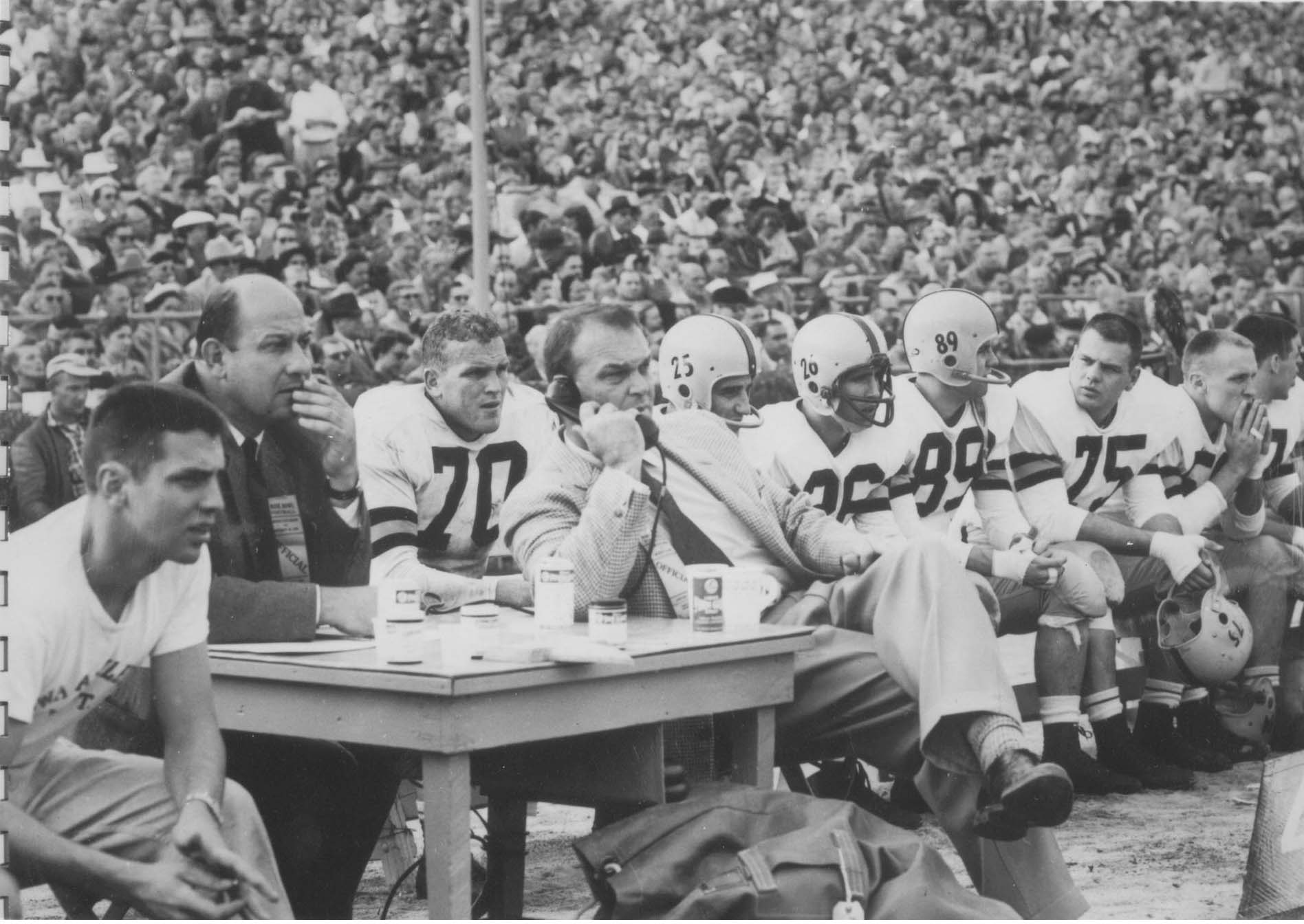
Book about 1960 Iowa FB team highlights special era long gone, but never forgotten

By Pat Harty
IOWA CITY, Iowa – More than a decade has passed since Iowa radio legend Bob Brooks passed away on June 25, 2016 at the age of 89.
Bob was my personal Hawkeye historian, even better and more reliable than the internet, and mixed in with a little dry humor and wit.
Rarely did you ever see Bob Brooks, or as most affectionately called him, “Brooksie” not wearing a suit coat and tie.
And it’s hard to recall when he was ever not willing to talk about the Hawkeyes.
Bob enjoyed being a talking encyclopedia, and he thoroughly enjoyed talking about the Forest Evashevski years in football; a glorious stretch from 1952 to 1960 in which the Iowa football team won three Big Ten titles, two Rose Bowls, four games against both Ohio State and Notre Dame and 37 games during a five-year stretch from 1956 to 1960 against just eight losses and two ties.
Iowa also had two Heisman Trophy runner-ups under Evashevski – lineman Alex Karras and quarterback Randy Duncan and two Outland Trophy winners – Calvin Jones and Karras.
It truly was a magical time, and with Brooks around, it was easy to relive those days.
Whether in a hotel restaurant on Friday night before a road football game, or during the weekly press conferences, Bob Brooks was always willing to share his expertise, crafted over six decades of covering the Hawkeyes.
The recent release of a new book about the 1960 Iowa football team, and why its author, William Hughes, believes the 1960 squad deserves to be the national champion, has sort of rekindled my memory and appreciation for Bob Brooks.
Brookie would’ve loved this topic, and he would’ve enjoyed the book titled, “Standing Up For The Hawkeyes.”
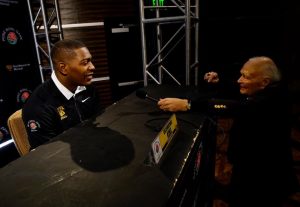
I didn’t know much about the Evashevski years until I moved to Iowa City in 1991 and started talking to Hawkeyes historians such as Brooks, former Iowa Sports Information Director George Wine and former local journalist Al Grady.
They were my connection to the past and their knowledge came with so much credibility because each had lived it.
My only memory of Forest Evashevski growing up was my mother teasing my father about leaving him for “Evy” if my father ever misbehaved.
My mom adored Forest Evashevski, and his success as the Iowa head coach made him even more adorable.
But it wasn’t until I started covering the Iowa football team on a beat basis that I started to appreciate the greatness of Forest Evashevski.
To say that I’ve had an ongoing fascination with Evashevski’s legend would be a fair statement.
Brooks once told me that nobody commanded a room like Forest Evashevski, his presence powered by a potent combination of respect, fear and intimidation.
In addition to being the only Iowa coach to win a Rose Bowl – he actually won two – Evashevski also taught students hand-to-hand combat while enrolled at the Iowa Naval Pre-Flight School in Iowa City in 1942.
He then left to serve three years in the military from 1943-45 during World War II.
Prior to that, Evashevski played football for Michigan from 1938-40 where he was a tough-as-nails linebacker and quarterback.
In those days, the quarterback was used mostly as blocker, and according to Michigan legend Tom Harmon, Evashevski was in a class by himself.
“I never saw a better one,” Harmon said of Evashevski, who helped pave the way for Harmon to win the Heisman Trophy in 1940; just a year after Nile Kinnick had won Iowa’s only Heisman Trophy.
Evashevski, who grew up in Detroit, recruited black players long before most other head coaches in his era had the courage and nerve to do so, and yes, it was partly do to his push for racial equality, but also because they were good football players.
Evashesvki wanted to win football games, and he wasn’t about to let something as foolish as racism stand in the way of doing that.
Evashevski retired from coaching after the 1960 season at the age of just 42.
He would go on to serve as Iowa’s Athletic Director during the tumultuous 1960s, and let’s just say that Evashevski was a better coach than athletic director.
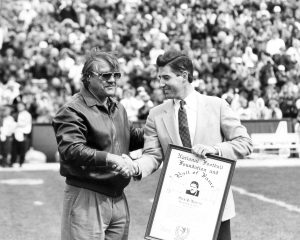
He was also a master recruiter, using his connections in his home state of Michigan to land star recruits such as running back Willie Fleming out of Detroit.
Though Fleming played just one season for Iowa’s 1958 Rose Bowl team, that was enough time for him to become a Hawkeye legend.
According to Bob Brooks, Willie Fleming was arguably the most exciting player to ever wear an Iowa uniform.
Bob and I had a conversation about this topic during the 1997 season when former Iowa running back Tavian Banks was enjoying a record-breaking season.
Brooks put Fleming in the same group with Banks and with another Hawkeye legend, Ronnie Harmon, and Brooks said that Fleming might have been the most explosive of the three.
Fleming scored two touchdowns in Iowa’s 38-12 victory over California in the 1959 Rose Bowl. He finished with 85 rushing yards on just nine carries.
As impressive as Fleming was that day, fellow Iowa running back Bob Jeter was even better, rushing for 194 yards on just nine carries, highlighted by an 81-yard touchdown run.
Iowa also crushed Oregon State 35-19 in the 1957 Rose Bowl with over 15,000 Hawkeye fans in attendance.
One of my favorite Evashevski stories was told by his daughter during a guest appearance on KCJJ radio several years ago.
The story dates back to a Halloween night in the 1950s when one of Evashevski’s sons had his Halloween candy stolen while trick or treating near their house on Summit Street in Iowa City.
After learning what happened, Evashevski drove up and down Summit Street with his son riding in the car with him looking for the guilty party.
Sadly, many of the players from the Evashevski era have passed away, though Fleming still is alive at the age of 87.
Evashevski passed away on Oct. 30, 2009 at the age 91 in his home state of Michigan.
I had the privilege of meeting Evashevski once in person, though the exact year escapes me. I believe it was shortly after the Iowa Athletics Hall of Fame building was opened in 2002 because that’s where the meeting occurred.
To say that I was nervous, and in awe, would be an understatement.
So if you’re interested in Hawkeye history, and more specifically in the Forest Evashevski years, William Hughes’ book about the 1960 Iowa football team will take you back to that special era, one page at a time.

