





Identifying biggest problem holding back Hawkeye football

By Pat Harty
IOWA CITY, Iowa – Nearly six years have passed since the Iowa football team has had a quarterback pass for at least 300 yards in a game.
Nate Stanley accomplished that rare feat against Illinois on Nov. 23, 2019 at Kinnick Stadium.
He completed 18 of 35 passes for 308 yards in a 19-10 victory.
Meanwhile, passing for 300 yards isn’t nearly as rare for most other schools where downfield passing is almost taken for granted these days.
Perhaps the best way to illustrate just how unique Iowa’s passing offense is from a productivity standpoint, or lack there of, is to go even lower than 300 yards for a statistical point of reference.
When is the last time Iowa had a quarterback throw for at least 200 yards in a game?
The answer traces back to the 2024 season opener against Illinois State when Cade McNamara passed for 251 yards and three touchdowns in a 40-0 victory at Kinnick Stadium.
It was the most passing yards for an Iowa quarterback since the 2021 season and that still is true to this day.
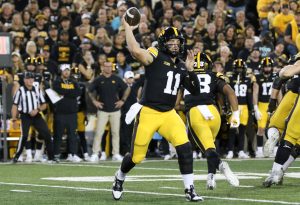
Graduate quarterback Mark Gronowski has scored 13 rushing touchdowns this season and has given the offense a dual-threat capability that it so rarely has had in 27 seasons under Kirk Ferentz.
But the passing offense with Gronowski playing quarterback has left much to be desired, the latest example being the second half of Saturday’s 26-21 loss to USC in rain-soaked Los Angeles when Iowa blew an 11-point halftime lead, largely because the passing offense was ineffective as Gronowski threw for just 25 yards in the second half on four completions.
Iowa rushed for 183 yards and averaged 5.5 yards per carry on a rainy day, and yet, still came up short.
Iowa is currently ranked 131st out of 134 FBS teams in per-game passing yards, averaging just 133.2 yards per game.
This isn’t all on Gronowski’s shoulders.
Iowa’s downfield passing woes have festered for years, making it a more deeply-rooted systematic problem that is impacted by personnel, strategy, and at times, circumstance.
Compared to a lot of today’s head coaches, Kirk Ferentz is conservative and cautious with his approach to offense.
He doesn’t like to risk making turnovers, and there probably is more of a risk in throwing downfield than running between the tackles.
Even though offensive coordinator Tim Lester calls the plays, Kirk Ferentz still has final say about everything.
And with how conservative Iowa became on offense in the second half against USC, you wonder if Ferentz encouraged Lester to use that approach, playing not to lose after leading 21-10 at halftime.
You can’t blame it on the rain since Iowa came out firing in the first half.
But in Ferentz’s defense, he has shown a willingness to throw downfield when the right pieces are in place to do so.
His 2002 Iowa squad was a joy to watch on offense as Brad Banks took turns throwing downfield to a talented group of pass catchers that included tight end Dallas Clark and receivers C.J. Jones, Maurice Brown and Ed Hinkel.
But that was also 23 years ago, and much has changed on offense since then.
Iowa also won a share of the Big Ten in 2004 while relying almost exclusively on its passing attack led by quarterback Drew Tate, who was named the Big Ten Offensive Player of the Year that season. The running back position had been decimated by injuries, leaving it up to the passing attack to carry the offense.
But that was 21 years ago, which is a lifetime in college football.
Former Iowa head coach Hayden Fry is often credited with lifting the Big Ten Conference to another level from a passing standpoint. The Big Ten was known mostly for having a three-yards-and-a-cloud-of-dust mentality until Fry showed up in 1979 with his more modernized approach to coaching offense.
Iowa had a quarterback make first-team All-Big Ten seven times from 1983 to 19991, and three-time selection Chuck Long was the first Big Ten quarterback to throw for 10,000 yards in a career.
Chuck Long and Chuck Hartlieb, who made first-team All Big Ten for Iowa in 1987 and 1988, used to make throwing for 300 yards in a game look easy.
And who was their offensive line coach in those days?
The answer is Kirk Ferentz.
So Kirk Ferentz has been affiliated with potent passing attacks before at Iowa.
He knows what it takes for a passing offense to click, and yet, his passing offense with four different offensive coordinators rarely has been productive.
And while it’s true that football has changed dramatically on both offense and defense since the 1980s, some things will never change, including the importance of throwing with accuracy and making the right reads.
It seems fair to say that Iowa’s quarterbacks in recent seasons have suffered from a lack of throwing accuracy, because there have been too many times when a receiver has had to break stride or adjust his body to catch a poorly thrown pass. Precious yards are lost every time that happens.
Gronowski is just the latest in a growing list of Iowa quarterbacks who have struggled to throw downfield with any consistency.
Tim Lester is the fourth different offensive coordinator to work under Kirk Ferentz at Iowa.
The running game has improved significantly under Lester, who is in his second season at Iowa, but the passing offense has basically been more of the same.
That’s why it was almost stunning to watch as Iowa marched right down the field on its opening possession against USC and scored a touchdown with the passing offense leading the way.
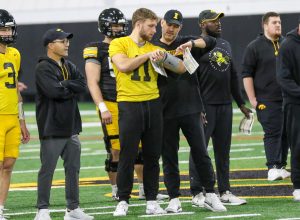
What Gronowski and his cohorts pulled off on that drive was a rare thing of beauty, a mix of power running and precise downfield passing. Lester was both aggressive and imaginative with his play calling in the first half, while Gronowski made a couple nifty throws on Iowa’s opening drive, including one near the sideline to Jacob Gill, who then turned it into a 44-yard gain.
Gronowski’s pass to Gill was right on the mark and thrown into a tight window.
Gronowski also made an impressive throw to receiver Kaden Wetjen late in the fourth quarter that would have given Iowa a first-and-goal.
However, Wetjen’s right foot barely scraped the sideline, making him out of bounds.
Those were two big-time college football throws, the kind of passes that are needed to compete at this level.
So Gronowski has the ability to do it, but where he falls short is consistency, as has been the case with all of the Iowa quarterbacks in recent seasons.
Spencer Petras made some spectacular throws during his time as a starter from 2020 to 2022. He just didn’t make enough of them.
But it wasn’t always his fault.
Gronowski has passed for over 11,500 yards as a college quarterback, but most of those yards were compiled during his four seasons as a starter for FCS power South Dakota State, where the competition wasn’t equal to what Gronowski is facing now.
But that’s still a lot of passing yards for any level of competition.
It makes you wonder if it has been more a case of the quarterbacks holding back the Iowa system or the Iowa system holding back the quarterbacks, or a little of both?
Whatever the case, Iowa’s downfield passing attack has failed to evolve, and that more than anything is why Iowa continues to fall short in its quest to be elite.
Defense and special teams have consistently been rock solid, and while there have been some miscues and shortcomings this season, both units still have performed well enough to have held up their end of the deal.
Iowa’s four losses to Iowa State, (16-13), Indiana (20-15), Oregon (18-16) and to USC (26-21) were a by a combined 15 points.
Iowa State, Indiana and Oregon were also held to a season low for points.
Defense isn’t the problem.
A couple years ago, Iowa struggled to do just about anything on offense. There were times when just completing a forward pass seemed close to impossible.
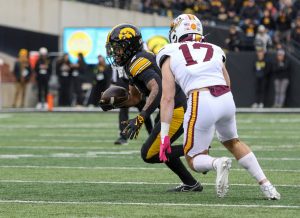
The offense became a source of ridicule, a national punchline.
The situation became so bad that Brian Ferentz was fired as the offensive coordinator with four games left in the 2023 season despite being Kirk Ferentz’s son.
Iowa had sent a message loud and clear saying what was happening on offense wouldn’t be tolerated anymore.
Kirk Ferentz learned to accept that message and he would then go on to hire Lester to replace his son.
The offense as a whole is certainly in a better place than it was two years ago.
But the inability to throw downfield with any consistency continues to haunt this Iowa team, which will face a struggling Michigan State squad in the final home game on Saturday at Kinnick Stadium.
Iowa is 6-4 overall and far from the playoff hunt, and has now lost 13 straight games against ranked opponents.
The motivation now, besides playing for pride, will be to earn the best possible bowl invitation.
If it’s any consolation, Iowa doesn’t have a bad loss this season, whereas last season Iowa had two head-scratching losses against Michigan State and UCLA.
Both games were played on the road, but the two opponents at best were mediocre.
Iowa will honor its seniors prior to kickoff on Saturday, and like every senior class, this group has stayed the course and sacrificed a lot of blood, sweat and tears along the way.
There is so much to like about Hawkeye football right now, the stability and culture, the consistency and toughness; the team-first mentality; all those things standout under Kirk Ferentz, who is the Big Ten’s all-time winningest football coach with 210 victories.
Now if he and Lester could just fix the passing offense.
.
.


