




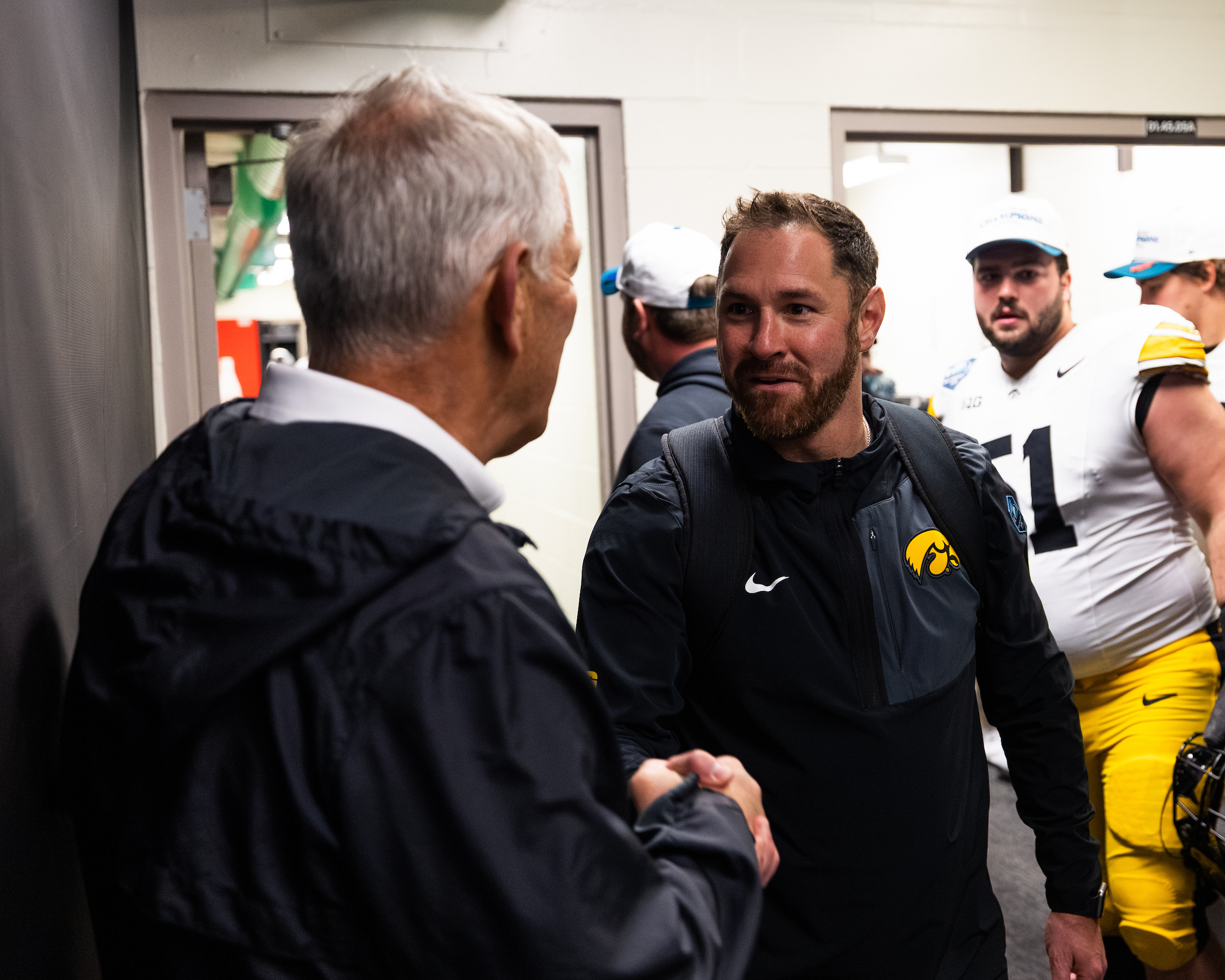
Chris Polizzi 4/22/26 spring football press conference transcript

IOWA CITY, Iowa – Chris Polizzi met with the media on Wednesday, and for the first time since being named Iowa’s new special teams coordinator in January.
Polizzi replaced LeVar Woods, who had been Iowa’s special teams coordinator since 2017. Woods resigned in December to become the assistant head coach for Michigan State as well as it special teams coordinator.
Iowa was consistently ranked among the best in the country on special teams under Woods, and now Polizzi is faced with the challenge of trying to uphold that standard.
Part of the challenge facing Polizzi is having replace star return specialist Kaden Wetjen, starting kicker Drew Stevens, and starting punter Rhys Dakin.
Wetjen and Stevens both exhausted their eligibility last season, while Dakin transferred to Michigan State.
Here is Polizzi’s press conference transcript:
CHRIS POLIZZI: Thank you, everyone, for being here. Appreciate your time. Appreciate what you guys do covering our program.
A special thank you to Coach Ferentz. Tremendous opportunity to lead special teams. It has a very proud tradition not only within our program, but within the state and on a national recognition level.
I want to highlight my staff. Brock Sherman and Stetson McIlravy, having them remain as part of the staff was a critical piece, but then having the ability to add the knowledge and experience of a guy like Kevin Spencer, who was so impactful on every day and in every facet of the game, especially with my transition.
I’m sure you guys are eager to know some of what the differences are going to be, but I want to highlight some of the things that are the same as far as special teams go. The structure has been very productive over a number of years. The techniques that produce the results are the same, and the expectations, frankly, from within the building and outside the building are the same.
The things that will be different from a special teams standpoint, and I shared this with the team in our first meeting, was the communication style. I love LeVar. He’s a friend of mine. We’re different people, different coaches. And the standard, the standard of what was special teams when Coach Woods took over is completely different now than what the standard is of today.
Kaden Wetjen is a two-time Jet Award winner. Drew Stevens was a record-breaking kicker. I go back to the last punter we had graduate from the program was the highest drafted punter in recent years.
So the standard is what the players and the previous coaches have set, and we cannot go backwards from that standard. So those are some of the things that will be different.
I want to highlight some of the guys that aren’t specialists that have been working really hard and just doing the things that we ask them to do in showing up on a daily basis. Landyn Van Kekerix is one that consistently shows up in the drills and the unit work. Doing his job, looking for the opportunity, hungry for the next opportunity.
Another guy, Nolan DeLong keeps putting on clinic tape of the technique that we’re asking him to do and the physicality and the willingness to push through to the next level of whatever is the progression of our scheme.
Then another guy Luke Gaffney, who is from a defensive line standpoint is maximizes every opportunity that is afforded to him in the drill work and again in the unit work, and I’m appreciative of him.
We have a lot of work to do to get to where we want to get to, but the whole group has embraced it, and it’s been a lot of fun to not only have meetings with the guys, but also get on the grass and see the enthusiasm they have to push this thing forward from a special teams standpoint.
Q. Coach, obviously Kaden Wetjen is a big spot to fill. Who are some guys that you have considered that could replace that spot this season?
Q. Zach Lutmer is the first one whose actually kind of had the ball in his hands more often than some other guys, so there’s a comfortability there. He’s caught off the Jugs. Hasn’t necessarily had a whole lot of game experience with it, but you trust a guy that’s been in the spotlight. More than from a skills standpoint. It really is a trust standpoint.
At the end of every one of those transitions of the ball from punt to punt return, kickoff to kickoff return, you want to finish the play with possession of the football. So that’s first and foremost.
Some other guys, KJ Parker has been back there getting some work. You’ll see him on Saturday in Kinnick. Same with Lutmer.
Jaylen Watson is a guy that has really worked to become a better punt and kickoff return guy. Brevin Doll is another guy who works diligently on the Jugs machine to try to work through that, and even Reece Vander Zee working his way to being a guy that you just trust with the football.
But I’d say there’s nobody out of the competition at this point. You should see the line for the Jugs machine, it’s like when the Diary Queen down on Riverside opens up, that line is down around the corner. It’s a long and distinguished line of guys that are working towards it.
We won’t know that until literally we run out of the tunnel at NIU.
Q. I wanted to ask you about the punting competition. You have two new punters on campus. One of them an Aussie. What is that competition like so far?
CHRIS POLIZZI: It’s been great. Both guys are working hard, and they both bring a lot of different elements to the table. One is right-footed; one is left-footed. One has kicked on a collegiate level. One this is the first time he’s ever put on a helmet.
They both have tremendous leg talent. They both work well with one another. That’s why I mentioned that it’s a healthy competition. They trade notes with one another. They review film with one another. They catch Jugs off one another. They’re continuing to in a healthy manner critique one another.
It’s been great to see them both progress as we go through the different styles of punts that we have in our arsenal. You know what mean? Whether it’s a traditional spiral punt or pooch punt for short yardage, or even our rugby-style punts where it’s a little bit probably more natural for Boston working on getting outside the pocket, but Tanner has done that as well, both on the high school and collegiate level.
So it’s been a lot of fun to work with those guys. They’re both tremendous teammates. The amount of positivity that they bring not only to our small group, but to the team as a whole is a lot of fun. I’m excited to see them continue to progress.
Like I said, we have a lot of work to do, but it’s been a very healthy competition.
Q. What attracted you to the position, first of all? Then second of all, being an analyst last year, how closely did you work with special teams?
CHRIS POLIZZI: I was here previously, and I didn’t know much about the program prior to 2012. I was still a young coach at that time when I came here. My wife and I were engaged at the time. So our first years being a married couple were spent here in Iowa City literally right down Melrose.
When you go through this process of being a coach and you have these aspirations of I’ll move anywhere, I’ll go anywhere, you know what I mean, I just want to get on the grass and coach and have that opportunity. That was one of the things I met with Coach Ferentz of when my graduate assistantship is up, if you want to coach, you got to go coach.
That road out of Iowa City led me to Western Carolina and Tennessee Tech and Tennessee Martin and Tulsa where you are in different communities that have different advantages, different warts. You’re working for different head coaches, different administrations. What are their values? What’s the type of program they want to build?
Everywhere I went I guess I used the term, you can’t enjoy the sweet until you’ve tasted the bitter. Everywhere I went there was something off or just didn’t feel right about where it was. Believe me, I had tremendous experiences there, but it just wasn’t Iowa. I think it all stems from the head coach.
Everything that we do is predicated off his vision and what he wants to accomplish with our customer base, which is our players. All of our players here, Coach wants to make sure they have a great high school program-like experience. I think when that is the core root of all of your decisions, 99% of the time they’re going to be the right decision for the player.
So what attracted me back here was the opportunity to work with ask for Coach Ferentz. That all he does is collect great people in and around the program and people that obviously stay for long periods of time because they respect the opportunity to work in such an environment. The idea is to recruit the right type of player, to develop the right type of player. That’s not the way all across the country.
So attracted me to that was the opportunity to grow in my role here as an analyst. I did work with special teams with LeVar, but on a periphery level. I was more concerned about the defense and the secondary and how they were performing, but an opportunity to expand my reach with the players and to try to pour what life lessons I have into them is really what excites me.
When my hand hits the door handle here in this building, I absolutely love it, and I can’t say that that’s the same in a lot of other places. I can’t wait to be here. I can’t wait to work with these players. I can’t wait to be in this building. I really enjoyed my time here and just looking forward to the opportunity to continue to pour into these kids all the life lessons that I’ve had the opportunity to experience.
Q. You got tasked with a pretty intense overhaul in terms of the special teams unit, some of it already started coming together before you were able to assume the role officially. I’m curious what has that been like stepping in that so many names that Iowa fans know are now gone, and especially considering how closely tied LeVar Woods was to this university? What has this experience been like in that sense?
CHRIS POLIZZI: Good question. It’s event, response, outcome. You’re going to control about 10% of the world around you. 90% of it is going to be your response to the events, and again, leading back with Coach Ferentz. You see how he handles responsibility and opportunities and change and flux, and it’s always with a steady hand at the wheel and not with a knee-jerk reaction.
The exciting part about getting to know these guys is getting to teach them a little bit about how our culture rates here at the University of Iowa. You know what I mean? Believe me, Kaden Wetjen is a generational player. I believe that, but a lot of the success that he had, he would be the first one to tell you this, is for the guys that are blocking in front of him and for the trust that his teammates had within him because of the way he worked in practice.
So when you have that type of, you know, continuity within some of the role players in our special teams, it allows for other guys to blossom when their opportunity comes.
Q. I wanted to ask about the kicking situation with Eli and Caden. One coming in; one that’s already been here. Would you consider it an open competition at this point? Can you just kind of speak to the progress that you’ve seen each of them make?
CHRIS POLIZZI: Sure. There’s no position within our program that’s not in competition, and I think that’s the beauty of sports is when you open up the competition like that and everybody has an opportunity, you let things play out as they will.
That’s what we have as one of our afforded deals is we have time. With Caden and with Eli, both guys work incredibly hard. Both have kicked in college. Not as much experience with Caden, but leg talent and leg strength for those guys is a very high level.
They, in turn, work well with one another and marrying their communication style of, hey, I think you’re a little open on there, or I think your shoulders are off on that one and working with one another. You know, as specialists you are kind of separate in practice. You’re forced to work with one another as everybody else is doing their drills and stuff like that.
They’ve been great. Again, we’ve challenged the group. We went out and kicked on Saturday in Kinnick, and the wind was all over the place, and the guys never whined, never complained. They just go out there and say, we’re going to have to kick in this weather sometime during the fall, and just went out there and competed.
Again, that’s one I don’t foresee us saying or naming any starter until we run out of that tunnel versus Northern Illinois just because I think you allow it as much time as it can to see who has the hot hand. You enjoy having the experience of two guys that you know can go out there and kick with confidence.
Q. I guess a two-part question. One, what were the conversations like with your family about when you got the job and the emotional high or whatever the case may be? Then right when that high came down, trying to prioritize everything that you had to do, just given all of the craziness that you taking over and the turnover and getting settled in and everything, how did you prioritize that and execute that?
CHRIS POLIZZI: It was funny. I’ve had job opportunities and things that, hey, I think this may work, and I think this may not work. I’ve made the mistake previously of informing my wife. This may happen, or this may happen, or this may happen. She’s says when it’s good and we can sign on the dotted line, let’s keep it at that.
I really didn’t tell her anything even as I was going through the interview process here until I had a final meeting with Coach Ferentz and said this is the direction, this is where we are going to go, this is how we are going formulate the staff.
I met her that night for Mexican. I had a small, little plant. I picked up my daughter from daycare. I walked in, and our daughter was holding it. She’s like, what was this? There was a card, and it said, I got the job. She was, like, oh, really?
It’s a dream come true. I hope I don’t get emotional here, but there were some times where I didn’t know if I would ever be standing here. I didn’t know if I would ever make it back to Iowa. I didn’t know if I would ever have the opportunity to coach with this caliber of player and with this caliber of staff ever again.
Being a coach, it stresses out your family. We’ve moved nine times, and I learned this from Rick Neuheisel a long time ago. There’s two kinds of coach’s wives. There’s great coach’s wives and ex coach’s wives, and there’s nothing in between. They’re either bought in or they’re with you for the long ride, or they’re like, I didn’t sign up for this. This is not how I envisioned my life going. My wife is one of the good ones.
For her, it was incredible. I wish I could have shared it with my mother who passed away, but my father was ecstatic, and believe me, he reads everything you guys put on paper and in print. It was a dream come true opportunity.
Then the same breath, you mentioned it, now it comes down to the jitters have left. Now we’ve got to put our heels in the dirt and do some work.
That’s where you rely on people like Brock Sherman and Stetson McIlravy, who have done it for a number of years and have done it with different elements to their preparation. It’s not just, we did this last year. It’s for the last three or four years we’ve done this, and this is why it switched, and this is why the terminology. That was one of the best things.
I sat down in the special teams staff room, and I said let’s go through and talk to me like I am an infant child. If there’s anything that we can do to clean this up from the wording to an adjustment on the name of what we call this, teach me so that as I go to teach this thing, that it makes total transparency, and I’m competent in what I’m trying to say to these guys, but it makes sense. If there’s something we can adjust on here, let’s do it.
They’ve been great, tremendous about those things. It has been a fun journey. I just pinch myself every day that I get the opportunity to work in this environment with these coaches.
Q. You clearly care about this. I wanted to ask your predecessor, LeVar, did something that I can’t imagine a lot of special teams coordinators or at least every special teams coordinator does, and it’s the buy-in that he gets. Special teams are cool around Iowa City. It’s not the kickoff guy. It’s not the kicker. It’s not the punter. It’s the seventh guy on kickoff who gets, like, one tackle every three weeks. How do you get your guys to buy into that every single rep of practice when oftentimes what they’re doing is running 70 yards down the field and just retrieving the football?
CHRIS POLIZZI: It starts in the recruiting process. We attract guys and sign guys that want to be at Iowa. If we have to trick them, if we have to lure them, if it’s because of a financial decision, Iowa paid me the most money, then that doesn’t go to the core of what we’re going to need you to do, which is work your tail off for nine months out of the year for a potential six to seven opportunities in Kinnick Stadium.
When you attract that type of player that realizes the value of special teams and for a lot of these guys, that’s their window. That’s their first opportunity to step on the field is that special teams unit.
Then you show them. I think one of the things that’s of value here, we did a team meeting the other day, and we’re showing clips of Bob Sanders as a true freshman, and the film is grainy. Some of these kids weren’t even born when Bob was running down the field, but you see the tenacity and ferocity that a young Bob Sanders as a freshman is running down tackling a guy from Kansas State.
You can show them, it’s been the same message here for 28 years and counting. You can see the success that this is where it started, and you can see where Bob Sanders finishes his professional career.
It starts with that opportunity, and he didn’t just wake up one day and want to run down as a gunner on punt. That’s the type of player he was. That’s the way he practiced. That’s just one instance of the number of plays that we can show guys.
I think it’s also a connection with the players. They have to feel that this is really important to you. That every rep here is critical. I don’t know when your number is going to be called, but you be ready when your number is called. There’s a lot of people counting on you to do that, but it starts with Rai Braithwaite and the strength and conditioning department where those things are emphasized. The detail, the attention to detail, in everything that we do is emphasized.
It just stems through the whole program. It’s almost an expectation that that’s the way we operate any time you’re wearing this moniker.
Q. As a defensive guy, you probably see the depth you’ve got at linebacker. What do you think of the depth you’ve got there? How can you use that in special teams that Seth has over there?
CHRIS POLIZZI: Those guys are not only core pieces to what we do from a special teams, but a lot of the toughness and physicality kind of comes out of that room, from a guy like Cam Buffington, who is a core special teams guy. Other guys that come out of that room, like, Jayden Montgomery is a guy that’s going to be a bellcow for us on defense, and I didn’t mention him as one of the three guys on there, but that’s because he’s had some experience, some success on special teams and defense.
Jack Laughlin is another guy that’s working his tail off. Burke Gautcher, Carson Cooney, all those guys. I know I’m missing some names in there, but there isn’t a guy on that — Billy Weivoda is working his absolute tail off, and he should be in high school. He should be going to prom. He sometimes doesn’t know what direction he’s going, but he’s going a million miles an hour trying to do exactly what we’re asking him to do.
If you don’t have every one of those guys traveling and having a role on special teams and that role they’re going to live and die whether they get that role down, and it may be one play. If you don’t have that, I think you’re going to struggle in special teams in whatever level of football you’re trying to get done.
Q. We’ve seen a lot of players develop from special teams into starter roles on the defense. How early on in development can you see that in a guy where this guy is going to be a starter and how important is that in development getting those guys rep on special teams?
CHRIS POLIZZI: I’ll flip it to you. There’s a lot of times we’ll say, I’m not putting you on frontline in the core of our punting team unless you are a starter. Kamari Moulton and Xavier Williams are fighting tooth and nail along with L.J. Phillips as for a role in that starting core group.
The same thing with Will Hubert in the back side and the shield portion of it. DJ Vonnahme and Ortwerth are guys that are fighting trying to be that Sam guy. I want guys that are starting — that our coaches trust to put in the starting role, because it’s the same thing. This is a critical transition of the football from one side to the other. We’re going from offense to defense, defense to offense.
You can see with some young guys that they see if I can just run down and maintain leverage on the football and work my tail off and just outwork the guy in front of me, I’m going to put myself in position to go make a play, or you go back to a guy like — and we’ve highlighted him, Zach Gabelmann. You’re going to have to dig back in your files to find who Zach Gabelmann is, but we have four or five clips of Zach Gabelmann and a quote that talks about — he said I’m just running down to the football trying to make a play or allow my teammate to make the play.
We have four or five clips of him absolutely murdering people on film, but it’s when you can show those things and point to a guy like that, it shows, whatever your role is, that one play has to be the most important play, and can we earn trust within you by continuing to work in development phases in our special teams periods or even our offense-defense periods where you can say this is same-as. The same tackling we teach in special teams, the same thing we teach in all of our tackling for defense. The same ball security drills and telling a receiver to press vertical and step on the toes of a defensive player before I break the cut. When I break the cut, I want to have the ball on the outside and get contact and lock it. It’s the same-as.
That’s another part that I mentioned. I’m going to stop rambling here in a second, but the amount of assistant coaches that are invested in what we’re trying to do. Abdul Hodge. Coach Lester comes down and throws balls when we are doing some of our special teams security stuff. Seth Wallace, Phil Parker, John Budmayr, Jay Norvell, who is running up and down coaching guys up on all of our special teams units.
It’s impressive to have some of those things. It just leads to the continuity. When the head coach sits in the back of your special teams meetings, everybody sits up a little tighter, everybody takes notes. It’s the same thing with the coaches. They understand the importance of special teams and they follow what the head coach leads the way on.
Q. Every plate you’re spinning right now figuring out positions, and a couple of weeks back NCAA announced a rule change on punts that it doesn’t feel like any coordinator in America is on board with. I guess how have you addressed that at all? How much focus do you put on things like that when it’s not necessarily taking away your create I have not, but what it could allow for on the other side?
CHRIS POLIZZI: We’re still not out of the woods on that one, so I’m not going to get into the weeds on the nuance of it. There’s frustration from coaches just because you see the issues that they’re trying to correct. I get what they’re trying to fix with the game, but we are taking, like, 10 steps backwards and just the efficiency of what we’re trying to do.
You do limit some of the creativity of what we’re trying to do from a special teams coordinator standpoint of just gain a slight edge without deceiving the opponent. We’ve talked about it. We’re not going to really adjust much of what we do just because it’s worked, all within staying compliant within the NCAA rules.
We still have a long way to go not only in the understanding of the rule, but the clarification of the rule, how it will be officiated, and, you know, I wish I knew the answers to that.


