




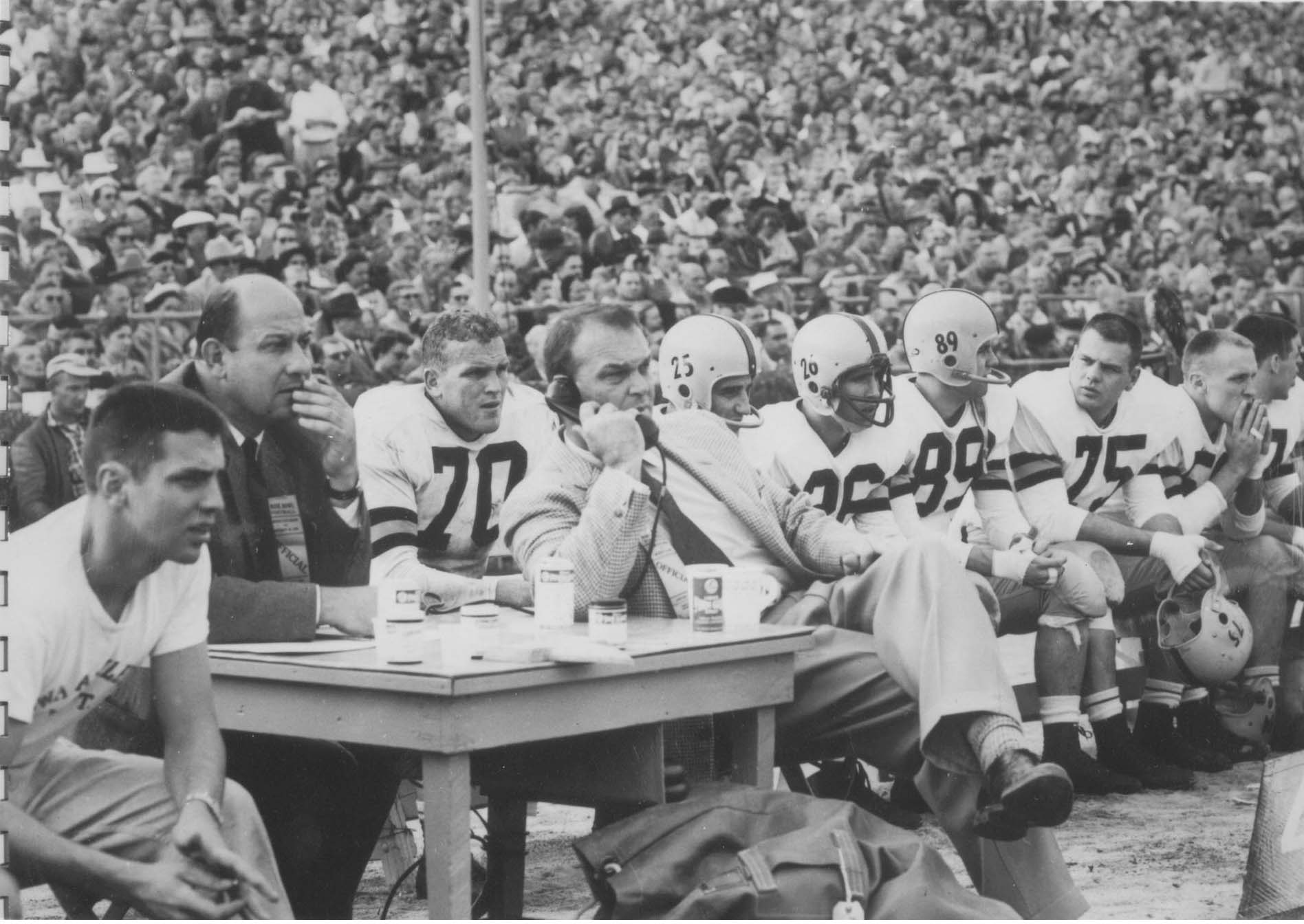
A look back at Iowa’s 1956 Rose Bowl champion team nearly 70 years later

By Pat Harty
IOWA CITY, Iowa – In early April of 1956, Iowa football coach Forest Evashevski, still frustrated with how poorly his offense had performed during the 1955 season, made a change in offensive philosophy that would help pave the way to Iowa’s first appearance in the Rose Bowl just one year later.
Evashevski installed the Wing-T offense, which was mostly new to the Big Ten, and the results were immediate and dramatic.
After finishing 3-5-1 in 1955, the Hawkeyes, led by their new attacking and deceptive offense, and by a stingy defense, shocked the college football world by compiling a 9-1 record in 1956. The breakthrough season was capped by a 35-19 victory over Oregon State in the 1957 Rose Bowl.
It was also the start of a five-year stretch under Evashevski in which Iowa combined to finish 37-8-2 from 1956 to 1960.
The 1956 squad will forever hold a special place in Hawkeye legend and lore for winning the Rose Bowl for the first time in program history.
The 1957 Rose Bowl was also Iowa’s first appearance in a bowl game.
Iowa also won the Rose Bowl two years later following the 1958 season, but is 0-4 in Pasadena ever since. None of the four Rose Bowl losses were even competitive, including Iowa’s most recent appearance – a 45-16 beatdown against Stanford following the 2015 season.
And while so much has changed in college football, on and off the field, since Iowa won its first Rose Bowl game nearly 70 years ago; what makes Iowa’s 1956 squad special and unique never will change.
Its memory will withstand the test of time, and this fall will be a special time as it marks the 70-year anniversary of Iowa’s 1956 squad.
Evashevski was in his fifth season as the Iowa head coach in 1956, and was just 38 years old.
His first four teams had finished 2-7 in 1952; 5-3-1 in 1953; 5-4 in 1954; and the previously mentioned 3-5-1 in 1955.
His record as the Head Hawk was pretty good after four seasons, but hardly great.
And as Iowa fans would go on to learn, Forest Evashevski was all about greatness, at least as a head coach.
But he was also a complicated man, who sometimes, was his own worst enemy.
That was especially true during Evashevski’s time as the Iowa Athletic Director throughout the 1960s, which also coincided with Iowa’s stunning decline in football that lasted until the early 1980s.
Evashevski, who passed away in 2009 at the age of 91, wanted to be head football coach and athletic director at the same, but was denied the power grab due to concerns that it would give him too much power and authority.
So, instead, after retiring from coaching in 1960 at the age of just 42, Evashevski ran the Iowa athletic department throughout the 1960s, and with what has been described as sort of grudge against the team he had coached for nine mostly successful seasons.
Evashevski also made things difficult for head football coaches Jerry Burns and Ray Nagel, and it proved costly based on how fast and how far Iowa fell in football after Evashevski retired from coaching.
Evashevski was an intimidating presence, even to his players. He had been a star football player for Michigan, and then taught arm-to-arm combat during World War II.
Evashevski grew up in Detroit and played at Michigan from 1938 to 1940, helping pave the way for Tom Harmon to win the 1940 Heisman Trophy as his lead blocker.
Evashevski played in the same Michigan backfield with his former high school teammate and close friend David Nelson, who would also become a highly successful college head coach, and was one of the early architects of the wing-T formation.
Evashevski turned to Nelson for help in installing the Wing-T formation at Iowa in 1956.
Evashevski felt he had the right personnel to thrive in the Wing-T offense, and as so often was the case, he was proven to be right, with help from his friend.
It wasn’t until 1981 in Hayden Fry’s third season as head coach that Iowa finally got over the hump in the post-Evashevski years.
After 19 straight non-winning seasons, Iowa finished 8-4 in 1981, but the fourth loss was a deflating 28-0 thrashing against Washington in the 1982 Rose Bowl.
That brings us back to the 1956 team, which featured Kenny Ploen at quarterback, Jim Gibbons and Frank Gilliam as receivers, two-way back Bill Happel, and a disruptive two-way lineman named Alex Karras.
The defense already was in place, and once things were fixed on offense with the Wing-T, the 1956 squad was off and running literally and figuratively.
Ploen rushed for a team-high 487 yards in 1956 and passed for 386 yards.
His playing style fit perfectly in the Wing-T offense and that was on full display in the 1957 Rose Bowl as Ploen rushed for 59 yards on just eight carries, highlighted by a 49-yard touchdown run in the first quarter, while passing for 83 yards on 9-of-10 completions.
It still ranks as one of the greatest individual performances in program history.
Iowa’s Wing-T offense relied on quick strikes, deceptive fakes and boot legs to keep defenses off balance and guessing.
The Iowa defense also held four opponents scoreless in 1956, including Minnesota and Ohio State in back-to-back games in which Iowa won by scores of 7-0 and 6-0, respectively.
The wins over Minnesota and Ohio State in November showed that the Wing-T offense still was a work in progress. But a 48-8 rout of Notre Dame in the regular-season finale, followed by the 16-point win over Oregon State in the Rose Bowl showed that the offense was moving in the right direction under Evashevski.
The 1956 squad won the Big Ten championship for the first time since 1922, climbed to No. 3 in the rankings and was the first Iowa team to win more than eight games in a season.
Over 15,000 Hawkeye fans attended the game in Pasadena, showing just how much the 1956 squad meant to its fan base.
Current Iowa head coach Kirk Ferentz was just one years old when the 1956 squad made history.
Ferentz will be 71 when the 2026 season starts.
Time has certainly caused the memories to fade, and has seen the passing of so many of the key figures from the 1956 season.
But what doesn’t change over time is the significance of Iowa’s 1956 Rose Bowl champion team.


