




Iowa’s come-from-behind win over Iowa State took total team effort, including from three unlikely players

By Pat Harty
IOWA CITY, Iowa – Football is often described as the ultimate team sport and that was certainly the case in Iowa’s 16-13 come-from-behind victory over Iowa State this past Saturday at Kinnick Stadium.
From the players who stood out from start to finish, such as receiver Tony Diaz and middle linebacker Cam Buffington, to Caden Buhr, who made three field goals, including the game-winner, to the lesser-known players who did the little things that sometimes are the difference between winning and losing; Iowa prevailed against its instate rival thanks to a wide range of contributions from a wide range of players.
If it weren’t for Tanner Philpott reaching back over his right shoulder to catch the snap on Buhr’s 42-yard game-winning field goal with 15 seconds remaining, the kick almost certainly wouldn’t have happened.
The snap, and the hold that take place prior to kicking a field goal, are easy to take for granted because way more times than not, nothing bad happens. The process almost always goes as planned, and while that was technically the case on Saturday since Buhr made the field goal, the snap was off target, making it hardly a routine catch for Philpott.
If Philpott hadn’t caught the snap, the game probably would have gone into overtime.
And it wasn’t a horrible snap by Ike Speltz, but just being a few inches wide right or wide left, or too high or too low, can cause the whole process to breakdown.
Tony Diaz’s 56-yard catch in the second quarter was one of the biggest and most impactful plays in Saturday’s game because it helped to set up Iowa’s only touchdown of the game, and because it finally lit a spark in what had been a listless Iowa offense.
It also thrilled the fans because few things in football are more exciting than a receiver catching a deep ball.
But it wasn’t anymore important than Philpott’s play, and it might have been less important since Philpott’s play actually led directly to the game-winning points.
If Philpott had his way, he’d be Iowa’s starting punter right now after transferring from Division III Simpson College where the Waukee native earned All-America honors last season.
He and true freshman Boston Everitt, who is Iowa’s latest punter from Australia, were both brought in to compete for the punting job, and to this point, Everitt has had the advantage, and he certainly helped his cause against Iowa State by punting six times for a 44.0 average.
Philpott as a competitor has to be disappointed with being the backup.
But he can’t allow that to be a distraction because being the holder on field goals is extremely important and takes focus and discipline.
Putting your ego aside is also part of being a good teammate.
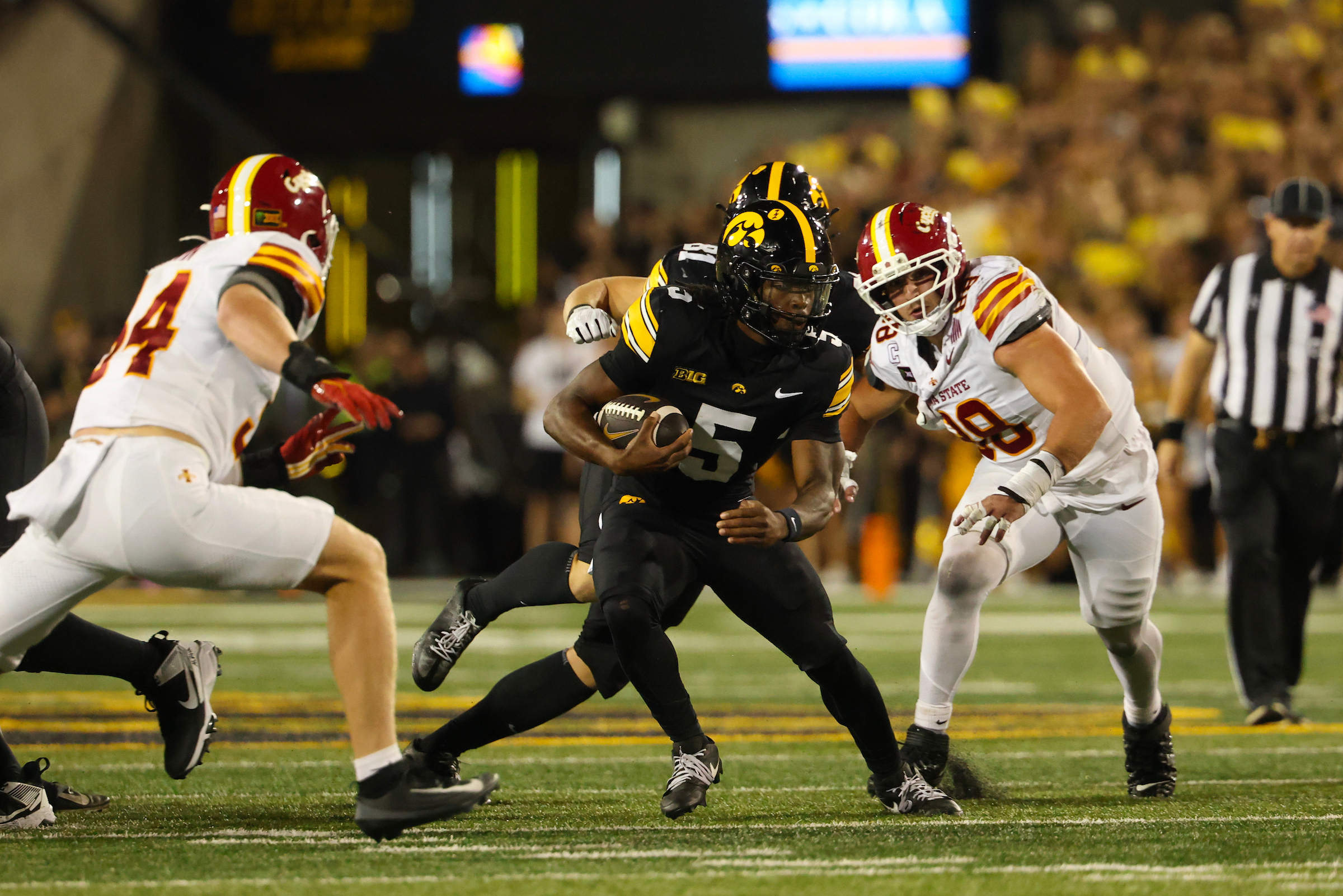
Second-year running back Nathan McNeil also made a key play in the win over Iowa State that helped set the stage for Philpott and Buhr to do their part.
Starting running back Kamari Moulton had just picked up a first down on a 4-yard run to the Iowa State 33 with slightly less than two minutes to play.
However, Moulton appeared to be in some discomfort after the play and was replaced by McNeil, who hadn’t had a rushing attempt to that point.
On first down, McNeil gained seven tough yards up the middle to the Cyclone 26 while absorbing multiple hits.
And while it tied for Iowa’s second longest run of the game, the seven yards gained on this play were special because of the late-game circumstances.
McNeil, who is from Tampa, Florida, also gained two yards on the next play, moving the ball to the Iowa State 24.
Iowa ran another play that gained no yards, but the nine yards gained by McNeil on two running plays was the difference between Buhr having to kick a field goal from 50 yards or beyond.
A 42-yard field goal is hardly a chip shot.
But it isn’t nearly as difficult as one from 50.
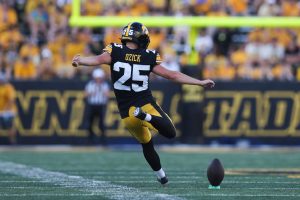
Speaking of kickers, Iowa’s backup kicker for field goals is Eli Ozick, who transferred from North Dakota State where he made 16-of-18 field-goal attempts last season.
It was easy to assume that Ozick would be Iowa’s field-goal kicker since he was added from the transfer portal for that purpose, and with his track record.
Caden Buhr, on the other hand, was an unproven walk-on from Bettendorf, but that still didn’t stop him from winning the job in preseason practice.
Buhr struggled early in the season opener, missing badly on his first point-after kick and missing his first field-goal attempt.
But he has since settled down and found his rhythm and range.
Ozick, meanwhile, is now handling kickoffs for the Hawkeyes, which isn’t the same as kicking field goals, but still very important.
Three of his five kicks against Iowa State resulted in touchbacks, including the final one in the closing seconds.
Tanner Philpott, Nathan McNeil and Eli Ozick are all backups at their respective positions, but when called upon against Iowa State, they all executed with the game on the line.
They each did their part in a team win, as did first-year Iowa special teams coordinator Chris Polizzi, who has the daunting task of replacing LeVar Woods.
Special teams were a strength under Woods, who was named Iowa’s first special teams coordinator in 2017. He held that position through last season, but is now the special teams coordinator and assistant head coach at Michigan State.
“It’s a good start. We’ve tried to emphasize—I mean, we’ve always emphasized special teams for 20-plus years,” Kirk Ferentz said after win over Iowa State. “We benefited when the NCAA allowed us to expand the staff and make LeVar the special teams coach, because I think that has some inherent advantages if you do it right. LeVar did an outstanding job here, and we had total confidence Chris would do a great job, too. He’s got good support, good guys in the room there with him, other coaches that are helping him make the transition just like LeVar did in 2017.
“I think a lot of it is we believe in it, and we do more than talk about it, we invest in it. But it all circles back to who those players are.”


