




Iowa football has to avoid another post College GameDay collapse

By Pat Harty
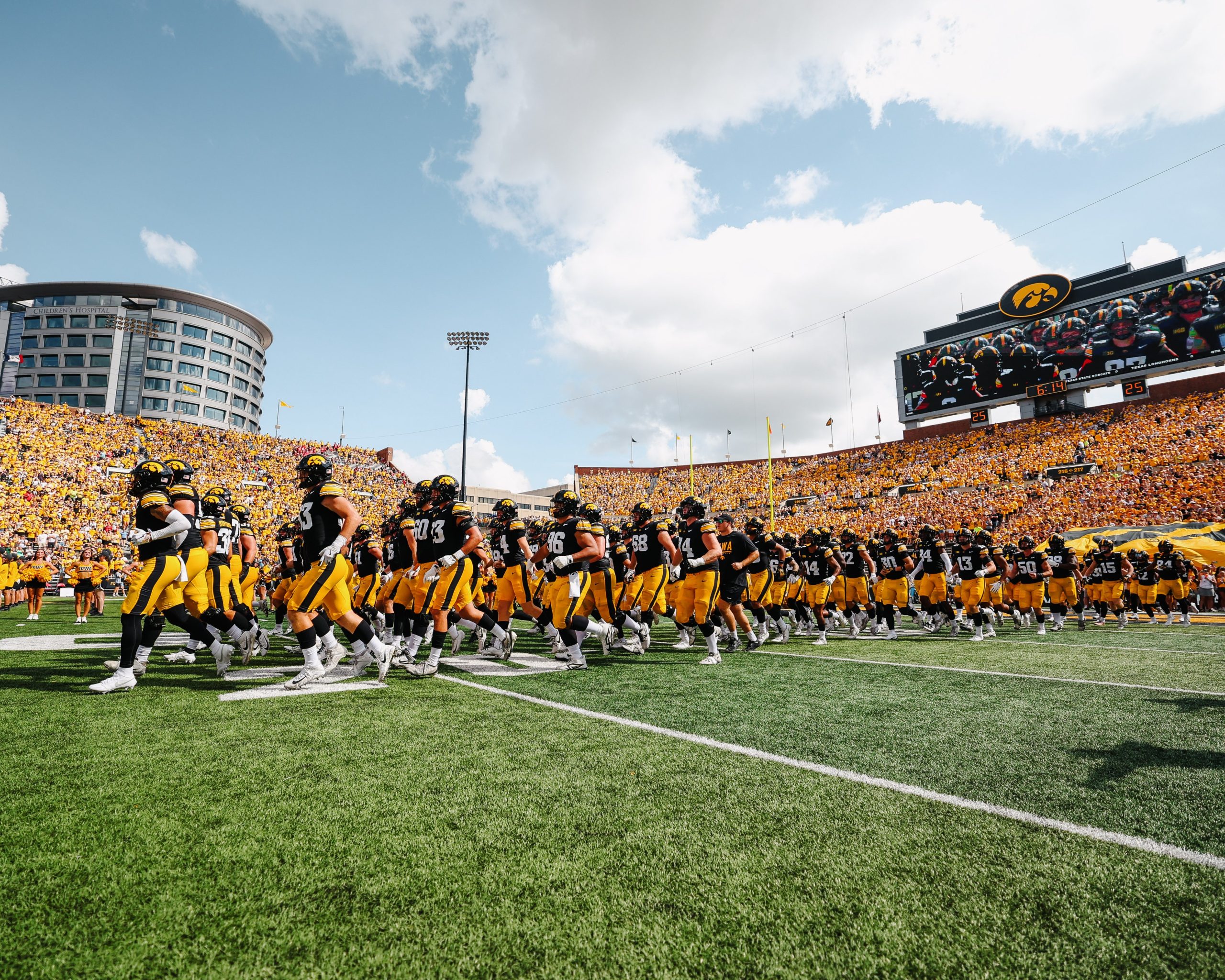
IOWA CITY, Iowa – Unless you believe in the ESPN College GameDay curse, the Iowa football team isn’t in trouble just because it lost to a better team on Saturday at Kinnick Stadium.
Iowa’s 31-14 loss to Ohio State was certainly a blow, but it wasn’t unexpected, considering the Buckeyes were a 14.5-point favorite.
Just like there’s a 24-hour rule for the Iowa players after victories, it’s the same after losses, even on a weekend in which ESPN College GameDay was in Iowa City to promote the game, and the two programs.
The opportunity for a historic win was certainly there for the taking, but the Buckeyes, led by star receiver, Jeremiah Smith, were just too good.
Iowa hadn’t faced Ohio State in Iowa City since 2017 when the Hawkeyes cruised to a stunning 55-24 victory that will forever rank as one of the greatest wins under Iowa head coach Kirk Ferentz.
Unfortunately, for Hawkeye fans, Saturday’s game was more similar to the last time College GameDay was in Iowa City in 2006.
Ohio State was also the opponent that day and prevailed, 38-17, protecting its No. 1 ranking in the polls.
Iowa was 4-0 heading into both the 2006 game against Ohio State and into Saturday’s game against the Buckeyes.
So in both cases, there was, or is, plenty of season left to right the ship.
Iowa now faces a quick turnaround, and a long trip to the Pacific Northwest for a game against Washington on Friday night in Seattle.
The Huskies have their own problems with two losses to start Big Ten play, and with its running back position ravaged by injuries.
Iowa has struggled under Kirk Ferentz in games on the West Coast, but the current Iowa team hasn’t even played west of Iowa City yet this season, so let’s reserve judgement.
What the current Iowa team has to avoid is what happened to the 2006 Hawkeye squad after losing to Ohio State as it would go on to lose six of its last eight games, finishing 6-7 overall, one of just four losing seasons under Kirk Ferentz.
It would then take two decades for College GameDay to return to Iowa City.
There is no shame in losing to Ohio State, even at home, and by double figures.
There would be shame, though, if the Ohio State loss were allowed to linger.
That isn’t necessarily what happened in 2006 since Iowa crushed a respectable squad Purdue 47-17 in its next game on homecoming.
But then the wheels feel off as Iowa would lose its final five Big Ten games, scoring just six and seven points, respectively, in losses to Michigan and Northwestern.
Iowa had a rare late nonconference game against Northern Illinois right before Halloween in 2006, and it’s a good thing because the 24-14 victory at Kinnick Stadium was all that kept the 2006 squad from losing its final seven games.
The team did have a strong showing in the 2006 Alamo Bowl, falling to defending national champion Texas 26-24 in San Antonio, Texas.
Overall, though, the 2006 season was a huge disappointment, but not just from a record standpoint.
Following a 21-7 loss to Northwestern in early November at Kinnick Stadium, Kirk Ferentz came up with the phrase “fat cats” to describe his team’s mentality and approach.
“We looked like the fat cats and they played hungry,” Ferentz said. “I assume the responsibility for that happening. I have to do a better job of coaching and the coaching staff, collectively, needs to do a better job of coaching,” said Ferentz.
“We didn’t match their tempo of play and, when that occurs, you get the result you deserve. It hurts and doesn’t sit well, obviously.”
Ferentz avoided mentioning any specific players because that isn’t his style.
But for him to take his public criticism even that far was rare.
It was also a sign that the 2006 season was unraveling as Iowa would go on to lose its last three games.
The 2006 squad had its share of standout players, including quarterback Drew Tate, offensive linemen Marshal Yanda and Mike Elgin and tight end Scott Chandler, all of whom were highly respected seniors that season.
Still, something just didn’t click that season.
And with the phrase, “fat cats” Ferentz seemed to be suggesting that there was a sense of entitlement on the 2006 squad, perhaps with some of the younger players because it sure didn’t seem that way with the veterans on the team.
Tate had a fiery personality, and at times, maybe he was too emotional on the field.
But he was also the ultimate competitor, who played injured in 2006, and yet, still passed for 2,623 yards.
In 2006, Iowa wasn’t too far removed from its historic three-season stretch from 2002-04 when it won two Big Ten titles and compiled a 31-7 record.
That success would pay dividends in recruiting as Iowa had a top 10 recruiting class in 2005.
But that still wasn’t enough to keep the 2006 season from collapsing.
As for the current Iowa team, some of the players weren’t even alive in 2006, so they probably have no clue what happened after GameDay came to Iowa City that season.
Ferentz could always bring it up as a cautionary tale, though his current team seems to have a bigger problem with running the ball against power-conference opponents than with having a fat cat sense of entitlement.
There isn’t a game left on Iowa’s schedule that looks unwinnable, nor is there a game left that looks unlosable.
And while losing tests teams in different ways, the current Iowa team seems built to handle some adversity.
With veteran leaders such as fifth-year linebacker Jayden Montgomery and fifth-year tight end Addison Ostrenga, Iowa appears to have a strong culture in which being accountable and putting the team first are the top priorities.
It would be surprising if the current Iowa team lost its hunger along the way.
Ohio State didn’t play any harder than Iowa played on Saturday, just better.
Most of the Iowa players weren’t heralded recruits with their choice of colleges.
Ostrenga was committed to play baseball at Iowa until Kirk Ferentz offered him a scholarship, while Montgomery is a legacy recruit who picked Iowa over mostly FCS offers.
Montgomery is the son of former Iowa defensive lineman Jerry Montgomery. His mother also played volleyball for the Hawkeyes.
Iowa has another fifth-year player that starts at linebacker in Landyn Van Kekerix, who until this season played mostly on special teams.
Kirk Ferentz said recently that Van Kekerix had to choose between playing for Iowa or working full time on the family farm.
Van Kekerix chose the Hawkeyes and has stayed the course, though it’s probably been tough for him at times because playing college football is tough at times.
But with leaders like Van Kekerix, Ostrenga and Montgomery, it’s hard to see this Iowa team unraveling down the stretch.
Iowa added 16 players from the transfer portal this past offseason, but almost all of them either played for an FCS program or for a mid-major program last season, meaning they all have something to prove.
It’s also reasonable to assume that Kirk Ferentz learned from what happened in 2006 and is now better equipped to stop a fat-cat mentality from resurfacing.
This Iowa team certainly has some areas that have to be addressed, but from a hunger and from an attitude standpoint, it seems built for this challenge.


