




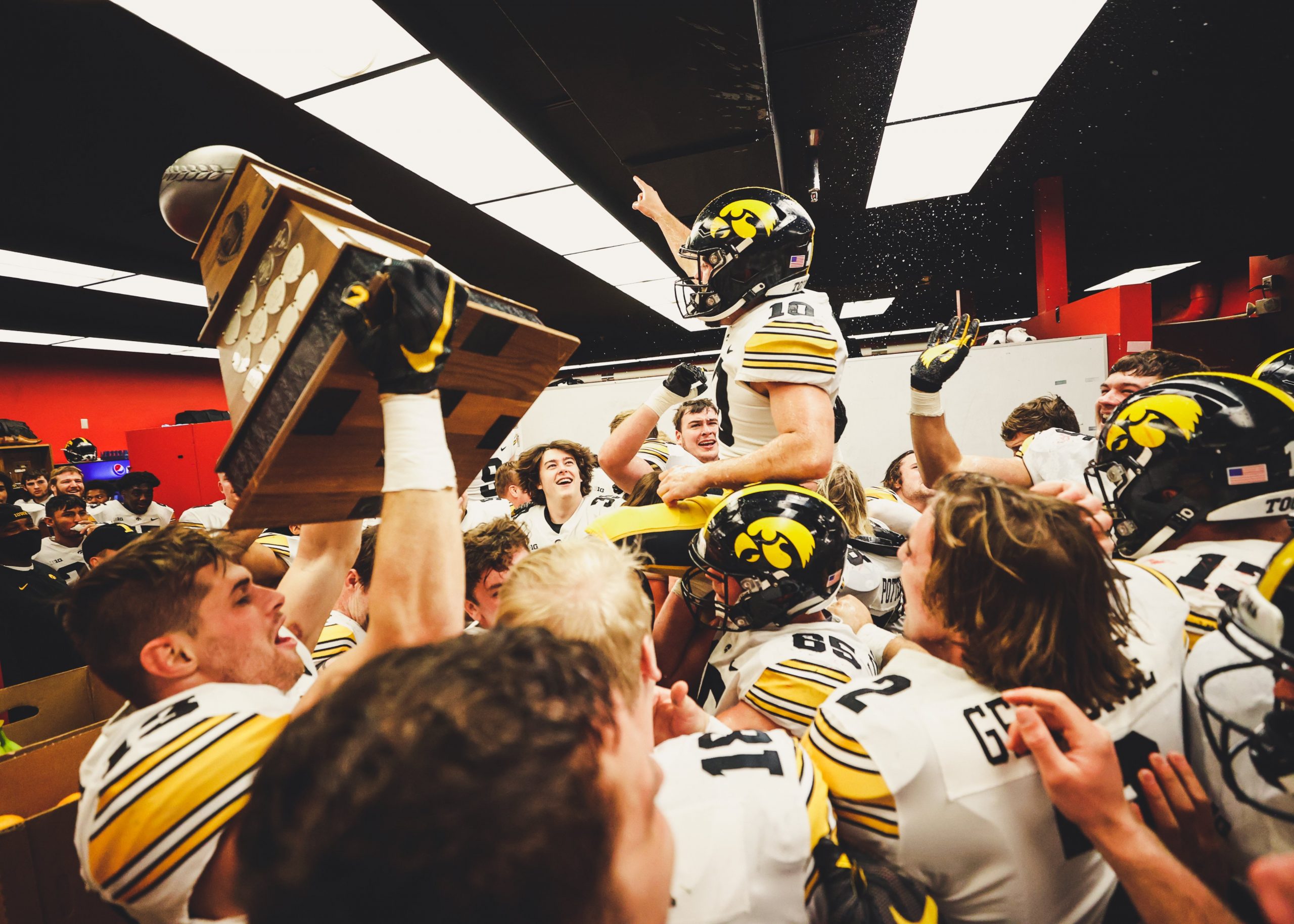
Game preview/prediction: Better team/program will prevail Friday in Lincoln

By Pat Harty
IOWA CITY, Iowa – On July 1, 2011, Nebraska became an official member of the Big Ten Conference.
The university had been approved as the conference’s 12th member on June 11, 2010.
The Nebraska football team as an official member of the Big Ten would then go on to win its first two games against Iowa in 2011 and 2012.
Cornhusker fans probably thought the dominance over Iowa would continue and, who could have blamed them under the circumstances.
After all, this is Nebraska football we’re talking about; the program with five national championships, 46 conference titles and one of the most devoted, and sometimes, delusional fan bases in all of college football.
It was easy to assume that Iowa as a development program wouldn’t be able to compete with the mighty Big Red Machine on a regular basis.
Prior to joining the Big Ten, Nebraska dominated the series with Iowa, compiling a 26-12-3 record against the Hawkeyes from 1891 to 200o.
In his first game as the Iowa head coach on Sept. 4, 1999, Kirk Ferentz watched his overmatched squad get manhandled by the Cornhuskers, losing 42-7 at Kinnick Stadium.
There was one play in particular that symbolized just how far apart the two programs were at the time. And that was the play in which Nebraska quarterback Eric Crouch ran over an Iowa defender.
But now turn the calendar back today, which Cornhusker fans don’t like to do, and there still is one team dominating this series, but it isn’t Nebraska.

Iowa has won nine of the last 10 games in the series, including seven straight from 2015 to 2021, and will try to continue its dominance when the teams meet for the 56th time on Friday in Lincoln, Nebraska.
Nebraska was once considered a model of stability and dominance under legendary head coaches Bob Devaney and Tom Osborne, while Iowa was a program in disarray and dysfunction for most of the 1960s and 1970s.
But then Hayden Fry came along in 1979 and finally ended Iowa’s misery in his third season as head coach by leading the Hawkeyes to a share of the 1981 Big Ten title and to the Rose Bowl for the first time since 1958 season.
Fry coached the Hawkeyes for 20 seasons before being replaced by his former offensive line coach, Kirk Ferentz, shortly after the 1998 season.
Ferentz has been coaching the Hawkeyes ever since and he now ranks as the Big Ten’s all-time winningest head coach with 211 victories.
Nebraska, meanwhile, has had six different head coaches since Ferentz became the head Hawk, and just three winning seasons since 2015, including the current season.
Iowa graduate center Logan Jones, who is a finalist for the 2025 Outland Trophy, and a native of Council Bluffs, Iowa, where he says Nebraska fans far outnumber Iowa fans, used to resent that Nebraska didn’t recruit him very heavily in high school.
Nebraska didn’t offer Jones a scholarship until after Iowa did.
And both schools recruited him as a defensive lineman, though Jones said Nebraska questioned his size.
Jones has since developed into one of the latest in a long list of success stories under Kirk Ferentz, who suggested to Jones that switching to center would be beneficial, and it sure has been.
“I don’t think I’d be the player I am today without the coaches and the support staff and everybody here,” Jones said. “I’ve had the same staff my entire career here. So that’s special, man.
“And they’ve (Nebraska) had however many? So to be able to play for this program and the coaches, the teammates you get to play with, it’s special.”
Jones doesn’t have to cling to the past for motivation anymore because he knows that picking Iowa was the right choice for him.
And it’s easy to see why Jones would feel that way, considering the paths the two programs have been on for quite a while now.
Nebraska, with its five national championships, has way more tradition than Iowa does.
But Iowa has been the better program for over a decade, pretty much ever since former Nebraska Athletic Director Shawn Eichorst caused a stir with his now infamous comment; “I had to evaluate where Iowa was as a program.”
Eichorst made that comment about 48 hours after having fired Bo Pelini as the Nebraska football coach in 2014.
Eichorst let Pelini go, even though Nebraska had rallied to beat Iowa, 37-34, in overtime in Iowa City for its ninth win.
Eichorst was praised by the Nebraska media for removing the emotion caused by the win over Iowa from his decision to fire Pelini, and for recognizing, that if Nebraska expected to climb back to elite status, it wasn’t about beating Iowa.
To say that Eichorst’s statement has backfired would be an understatement since Nebraska has gone from thinking it was above being compared to Iowa in football to now being dominated by Iowa in football.
And while most of the games between Iowa and Nebraska have been close over the past decade, including Iowa winning four games with last-second field goals since 2018, the so-called rivalry has been more one-sided than a political convention.
It’s hard to call Nebraska vs. Iowa a rivalry when one team has lost nine of the last 10 games.
The chance of it being 10 losses in the last 11 games for Nebraska seems reasonable, mostly because of one important statistical shortcoming, which is Nebraska allowing 167.45 rushing yards per game under head coach Matt Rhule.
Penn State shredded Nebraska for 231 rushing yards in last Saturday’s 37-10 beat-down in State College, Pennsylvania.
USC also rushed for 202 yards in a 21-17 victory over Nebraska on Nov. 1 in Lincoln, while Michigan gained a whopping 286 yards on the ground in a 30-27 victory on Sept. 20 in Lincoln.
Nebraska edged Cincinnati 20-17 in the season opener despite allowing 202 rushing yards.
Even Minnesota’s sputtering rushing attack gained 186 yards in a 24-6 win over the Cornhuskers on Oct. 17 in Minneapolis.
Nebraska’s run defense is more like a sieve, so look for Iowa, behind Jones and his offensive line cohorts, to exploit that weakness, early and often.
Iowa, using more of a running back by committee, is averaging 174.4 rushing yards, and 4.6 yards per carry as a team, both of which are respectable averages.
Nebraska, on the other hand, relies almost exclusively on Emmett Johnson, who is the first Big Ten player to have 1,200 rushing yards and 40 receptions in a season since 2017.
Johnson has 222 rushing attempts this season, and the next closest Cornhusker in rushing attempts is injured quarterback Dylan Railoa with 46.
The only other Nebraska player with more than 17 rushing attempts is new starting quarterback TJ Lateef with 26.
Johnson will face an Iowa defense that is only allowing 101.6 rushing yards per game, and 3.2 yards per carry.
But then Iowa will be facing a Nebraska defense that is only allowing 138.8 passing yards per game.
Kirk Ferentz should figure a way to convince graduate quarterback Mark Gronowski that when Friday’s game starts, it will already be the fourth quarter
Gronowski has developed this odd pattern of barely being able to complete a pass for three quarters, but then suddenly he flips a switch in the fourth quarter and starts throwing with tremendous accuracy and timing.
He threw for 117 of his 147 passing yards in the fourth quarter of last Saturday’s 20-17 victory over Michigan State at Kinnick Stadium.
Iowa got away with it against the last-place Spartans, but a similar passing performance for three quarters at Nebraska could prove costly.
That’s why Iowa has to run the ball early, often, and of course, effectively, and with Gronowski playing a key role on the ground.
The former South Dakota State star has 13 rushing touchdowns this season, and in just 11 games, is arguably the best running quarterback in 27 seasons under Kirk Ferentz.
And if Friday’s game were to come down to a field goal, as the 2023 game in Lincoln did with former Iowa backup kicker Marshall Meeder making a game winner; Iowa will turn to senior Drew Stevens, who is in a much better place now than he was two years ago when he was basically benched in the Nebraska game.
Stevens made a game-winner against Nebraska last season at Kinnick Stadium, and he’s also made 19 of 25 field-goal attempts this season, including a 58 yarder to tie the program record.
The closer you get to the football, and to the line of scrimmage, the bigger Iowa’s advantage is over Nebraska.
Assuming turnovers don’t become the story, Iowa should win simply because it’s a better team than Nebraska, and has been for the better part of the past decade.
Prediction: Iowa 27, Nebraska 20
Iowa (7-4, 5-3) vs. Nebraska (7-4, 4-4)
When: Friday, 11:08 a.m.
Where: Lincoln, Nebraska, Memorial Stadium (85,458)
TV: CBS
Radio: Hawkeye Radio Network
All-time series: Friday’s game is the 56th meeting in the all-time series. Nebraska holds a 30-22-3 advantage in the series that began with a 22-0 Iowa victory in 1891. Iowa has won nine of the last 10 in the series, including seven-straight from
2015-21.
Iowa’s 56 points in 2017 in the 56-14 win were the most in the series’ 54-game history. Since that 42-point win, the last seven games have all been decided by seven points or less.
Iowa has won the last six meetings in Lincoln dating back to 2015, but the Huskers lead 15-8-1 all-time in contests played in Lincoln. Four of the six games were decided by a single possession.
The Hawkeyes have kicked a game-winning field goal to beat Nebraska four times since 2018 (Miguel Recinos, 2018; Keith Duncan, 2019; Marshall Meeder, 2023; Drew Stevens, 2024).
The 1999 Iowa-Nebraska game in Kinnick Stadium marked Kirk Ferentz’s first game as Iowa’s head coach.
The first 10 games in the series were played in either Omaha (eight games) or Council Bluffs (two games). The series was even at 4-4-2 in those 10 meetings.


