




More of everything in sports these days, including media access

By Pat Harty
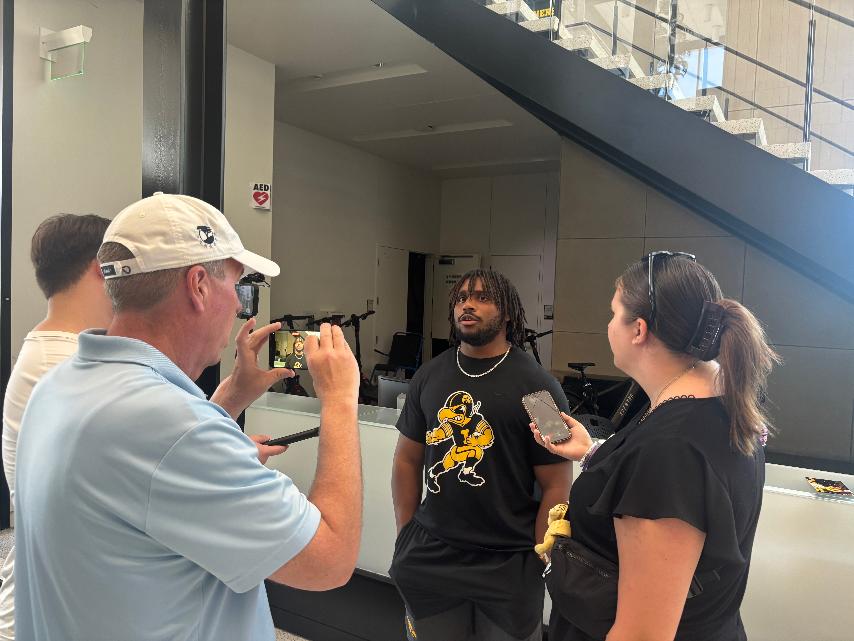
IOWA CITY, Iowa – In this age where head coaches and some athletes, both collegiately and professionally, are interviewed during timeouts, at the end of quarters, and, of course, at halftime, it should come as no surprise that 17 University of Iowa student-athletes were made available to the media on July 15.
Ten Iowa football players and seven Iowa men’s basketball players, along with Iowa men’s basketball head coach Ben McCollum, answered questions for as long as questions were being asked during two separate press conferences, though Iowa limited McCollum’s interview to about 16 minutes.
If you’re not promoting your brand, you’re falling behind.
Major League baseball even has players mic’d up during games because enough access is never enough access.
Little is left up to the imagination these days, but that isn’t necessarily a bad thing.
Prior to the internet and the launch of social media, covering the Iowa football beat was sort of like being a school teacher.
You basically said goodbye for the summer and looked forward to reuniting in the fall.
That’s why the Prime Time League was so popular because it gave access to Iowa men’s basketball players during the summer, and also to Iowa women’s basketball players in the latter years before both summer leagues were discontinued.
The Prime Time League was launched in 1987 in Iowa City and then disbanded in 2018.
It featured members of the Iowa men’s basketball team playing on different teams in pickup games with no cost for admission.
The PTL played its games first at City High then at West High and then finally at the North Liberty Community Center, which fortunately for everyone involved, had air conditioning.
There was little to no access to Iowa football players or Iowa football coaches during late spring and summer in the 1990s and 2000s.
You could arrange for an interview, but your best chance of connecting with Hayden Fry, or with one of his assistant coaches, was by attending an I-Club event in the late spring and summer and then listening as they addressed the audience, or maybe interviewing them afterwards.
I remember crossing paths with Hayden Fry at Big Ten Media day in the 1990s in Chicago, and we hadn’t spoken since probably the final spring practice in late April.
Fry greeted me by saying, “Pattie, I don’t know what you did this summer, but it obviously wasn’t sit ups.”
That was Fry’s way of saying, as only he could, that I had maybe put on a few pounds during my summer slumber.
His words inspired me to shed a few, but also showed how long it had been since we had last spoken.
Iowa wasn’t being difficult with the media in those days. That’s just how things were at most schools.
Unlike these days, there wasn’t a need to know everything at all times.
There weren’t even recruiting websites in the 1990s, which is probably hard for some to fathom given how today’s college sports landscape is flooded with recruiting websites for football and men’s basketball. Every Power 4 school now seems to have at least two or three national websites that cover recruiting 24 hours a day.
There also are way too many podcasts these days to even count.
The very first podcast was believed to have been recorded in 2003, but it took a while for this new form of communication to gain in popularity.
But now if you don’t have a podcast, you’re considered out of touch and failing to promote your brand at a time when self-promotion on social media is a top priority for the media.
The decline in local radio also has helped to shift the focus to podcasts.
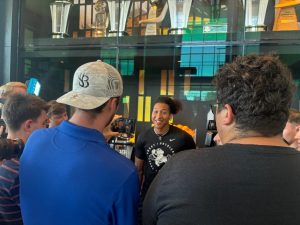
What we all take for granted these days in terms of access is a dramatic change from how things used to be.
Following the Iowa’s football team’s 2014 season, which ended with a discouraging 45-28 loss to Tennessee in the TaxSlayer Bowl, Iowa head coach Kirk Ferentz switched practice from late afternoon to the morning; hired a public relations company, presumably to help with his interaction with the media, and started making his players more accessible in the summer.
His assistant coaches also now participate in multiple podcasts with the local media during the summer.
Members of the Iowa football team and the Iowa men’s basketball team have twice been made available to the media this summer, while the Iowa women’s basketball team also has had two press gatherings so far this summer with a third to come next week.
Kirk Ferentz also has hosted the Iowa media at least twice for an in-depth look at how his program operates behind the scenes on a daily basis.
And while in-game interviews with athletes and coaches can be insufferable, there is no turning back.
There probably will come a day when a quarterback is mic-d up while scrambling from the pocket, along with the defensive end in pursuit of the quarterback.
The Big Ten has expanded from 10 teams to 18 teams, while the college football playoff has grown from four teams to 12 and will keep growing.
For the 2026-27 season, both the men’s and women’s NCAA Division I basketball tournament fields have expanded to 76 teams.
So if there’s more of everything, it only seems right that media access would be included because more is certainly better than less.


